When I passed the duty-free shop there with its perfumes, it smelled like you, after you’ve left a place. I’ve read the sense of smell is plastic, physical pattern matching: an airborne particle’s molecular shape sifted through the olfactory matrix, or whatever they call it. I am sure this jigsaw puzzle conception is simplistic and like most things I think I understand, incomplete, and the product of childish curiosity I long ago set aside for business. I remember before I got in an Uber in 2003: the flex of your hair gathered in my hand, the smell that arose from your scalp of fine shampoo from Soon Beauty on 22nd street, and the way your brain seemed so Edenic cased inside your head. So much marvelous stuff you think all the time, I’ll never know! And loving you, even, I still don’t know, and it’s come back now that I walk this bleak terminal, that curiosity.
The Magic Circle series returns to GainVille Café Friday, Nov. 15 for our annual Jaco Pastorius birthday salute and the launch of a great new book of poetry.
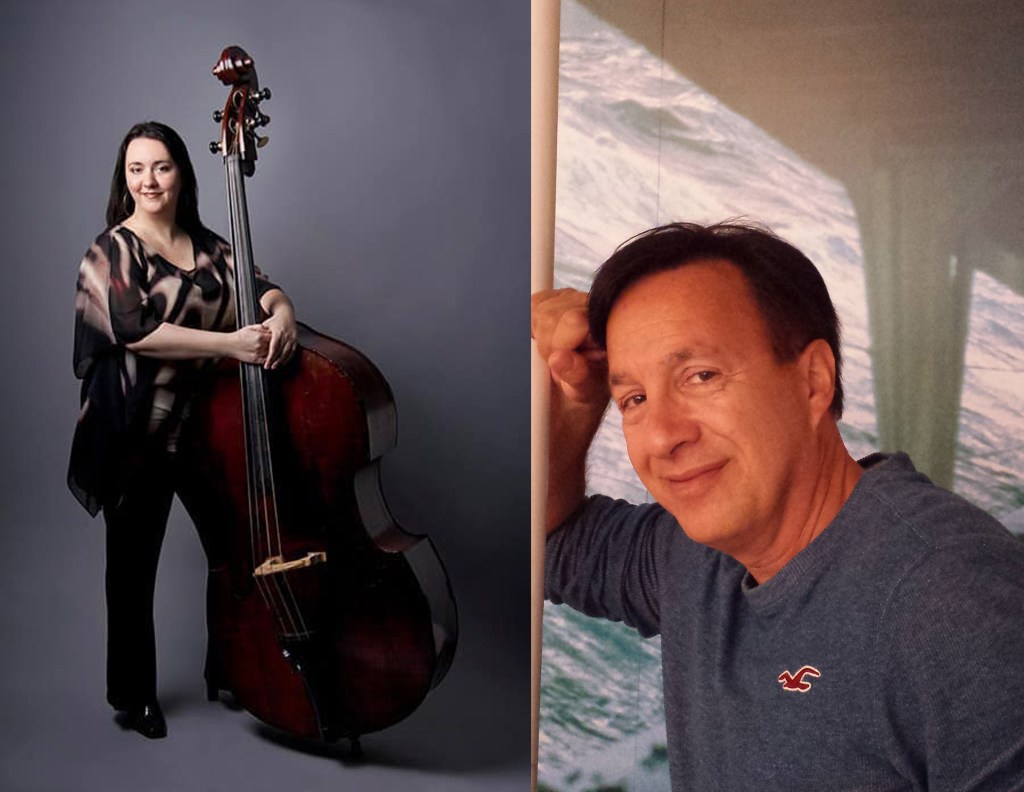
Featured reader will be DAVID MESSINEO and his new book of poems TWENTY MINUTES OF CALM. David is the longtime publisher of Sensations Magazine and the author of nine books of poetry.
Musical feature will be a birthday salute to JACO PASTORIUS featuring bass great and Jaco devotee JENNIFER VINCENT.
You don’t want to miss this! A $9 cover includes coffee/tea, dessert.
Also featuring the RED WHEELBARROW POETS and the long-running BRING YOU’RE A GAME open mic.
For the month of November, the Gang of Five is co-featuring four very accomplished poets, all recently published by Terrapin Books: Hayden Saunier, Sarah Wetzel, Gary J. Whitehead, and Michael T. Young.
Please join us on Wednesday, November 6, 2019, 7:00 PM, at the Williams Center, One Williams Plaza in Rutherford, NJ, to hear these fabulous poets.
About our features:
Hayden Saunier is the author of four poetry collections, most recently How to Wear This Body. Her work has been awarded the Pablo Neruda Prize, Rattle Poetry Prize, and Gell Poetry Award. She is the founder of the poetry + improvisation group No River Twice. (www.haydensaunier.com)
Sarah Wetzel is the author of The Davids Inside David, recently released from Terrapin Books, River Electric with Light, which won the AROHO Poetry Prize (published 2015) and Bathsheba Transatlantic, which won the Philip Levine Prize (published 2010). Sarah is a PhD student in Comparative Literature at CUNY’s Graduate Center.
Gary J. Whitehead’s fourth book of poetry, Strange What Rises, was published this year. His poems have appeared in The New Yorker and been featured on Poetry Daily, Verse Daily, The Writer’s Almanac, American Life in Poetry, the Guardian’s Poem of the Week, and the BBC’s Words and Music.
Michael T. Young’s collection, The Infinite Doctrine of Water, was longlisted for the Julie Suk Award. He received a fellowship from the New Jersey State Council. His poetry has appeared in Atticus Review, One, Rattle and Valparaiso Poetry Review. His poetry has also been featured on The Writer’s Almanac.
Please note: We must now pay $100 per month rent for the use the Williams Center for our readings. This is in addition to the $100 per month rent the Red Wheelbarrow workshop must pay for the use of their space in the Williams Center.
We need your help to survive and continue to hold our monthly readings. We will be asking for donations. A $5 per person donation is suggested. If we all contribute, we can pay the rent!
Dear Anton, I Borrowed Your Last Line But, Here, I Brought It Back Oh, No! Now It’s Wrinkled, Sorry
Every morning I go outside to fetch the newspaper from the box. Birds are already lined up on the telephone wire between the poles, waiting for Anton’s last line to lead them in song.
Paterson Falls is dammed; it splutters and jams; its water piles up, an ocean ladder reaching to the moon. The river refuses to fall, waiting for Anton’s last line to drop first.
Five-year-olds at the neighbor’s birthday party swing bats, but their swats cannot break the piñata. It refuses to share its sweets before Anton’s last line shows up.
The sun cannot cast a shadow without Anton’s last line to offer its silhouette.
Everyone is drowning in tears. Anton’s last line is missing.
Lawnmowers go to sleep, unneeded, as grass rends itself, distraught without Anton’s last line.
The earth opens up and swallows its own dust in fear that Anton’s last line has come to a bad end.
Arctic glaciers bob fiercely on the roiling sea, pleading for the safe return of Anton’s last line.
The heroic printer revs up— it shoots out one black duplicate of Anton’s last line!
Please, Anton, here, take it back, reunite this copy of your last line with the body of your poem.
Hold tight to your poems, Red Wheelbarrow Poets, hold tight.
Timmy’s baby-mother overheard me in my drinking and bullshitting around the campfire, and got in my face in her leopard-spotted jacket to attack my politics. She was so exercised, I had to ask her to withdraw some paces and get rational, and finally she calmed down, and we sat talking in the fishing chairs. It had been my first time shooting a handgun that day, and Timmy had called me Big Shoots. She revealed that she and Timmy were separated though they had flown here together on his father’s dime and raised their boy together in his house near the base where he was stationed, and he was taking care of her other kids too, from her previous relationships. This had been the arrangement for a couple of years.
I had been thinking all that time they were a nuclear family, and I looked through the campfire at Tim where he sat in hearing range the whole time she’d harangued me: he’d not moved, and looked inward in a wry, long-suffering way, just as he sat now and endured her divulging all his business, that he slept alone on the sofa since Afghanistan, and was drunk and so forth. He didn’t say anything to stop her: he had told me earlier about his low point, and she was not it.
Brian Burrows was a shrimp. I mean, we were ten, eleven, twelve years old In 1965 but even on a team of guys Not yet ready for puberty, he was small, Tiny as a mascot or an honorary batboy. We had to sell Critchley’s Candies for the Little League, Good stuff, sheets of green-colored mint Surrounded by thin skins of chocolate, but no one Was buying, even though we were canvassing House-to-house in our Flash Cleaners uniforms, Which you could get washed for a discount at Flash Cleaners.
When we met back at the corner, no one had made a sale. “They’re all cheapies,” Brian declared.
So, my father drove us across the river To Rutt’s Hut, where we waylaid the Saturday workers Coming out after a couple of dogs and a beer. The parking lot at Rutt’s was huge, A wraparound on three sides built On an abutment over Route 21, A kind of luxurious balcony over the Passaic River.
Business improved.
I guess real estate was cheaper in 1928 When Rutt’s opened, allowing a parking lot As generous in scale as the ones at Sea World or Disneyland. It hasn’t changed any, either. Neither Has the roadhouse, a ram shack With no windows, odd for a restaurant, Unless it had originally been a whorehouse Or a speakeasy, which it could have been in those Prohibition days.
Inside, Rutt’s sprawls through several environments. There’s a bar with a bunch of tables, in case you need to be close to the booze. Then a dining room behind a porous wall and, separately, A to-go operation where they shout back your order In some strange jack-tommy argot and there are more tables, Tables to stand at this time. Linoleum floors And fakewood walls complete the décor. It’s cash only.
There’s a logic to Rutt’s that predates credit cards and 911. A sign by a bell says if bell sounds, call the fire department. Since there are no windows, it still smells like 1965, A static waft made up of old farts And the fumes from ancient shots and beers.
Rutt’s lives on for its fried hot dogs, Called rippers because they rip in the hot grease. If you want to go long you can ask for wellers, Which are even better acquainted with the grease. Milk for the coffee comes in an oversized shotglass And is rarely filled more than halfway, waste not.
The place won best hot dog in America three years running.
I had a blind date at Rutt’s once. This was back When you had to answer personals by mail. I’m a writer; I did pretty well at this. When I called, the woman she said she was from Clifton. The only place I know in Clifton is Rutt’s, I said. I love that place, she said. Let’s meet there. And we did. And though I didn’t make the sale, She told me she had gotten two hundred letters, So I guess getting to meet her was like Being nominated for an Oscar, an honor Even if you don’t win.
Rutt’s is the kind of place where people always tell the truth. The glimpse of the river from the parking lot balcony, The sweetness of the mint, is why I keep coming back.
If you don’t get the rippers or the wellers, You can get one of Rutt’s Blue Plates. Corned beef and cabbage, boiled potato. Brisket and red cabbage, potato pancake. Soul food from 1965, a blue-plate year When no one had yet conceived of Tiny portions of food designed into geometric shapes.
My Mom, God bless her, taught me not to play with my food.
Flash Cleaners sucked the three years Brian and I played, But the hard Passaic winds that buffeted the field got us ready to be men.
Critchley’s Candies is still in existence. Started in 1957, it is located at 812 Kinderkamack Road, River Edge, NJ. A box of chocolate mints is $12.98. Flash Cleaners is still at 43 Meadow Road, Rutherford, NJ. Jack Tommy: short order argot for grilled cheese and tomato. Jim DeLillo sent me some Critchley’s Mints after we had lunch at Rutt’s; this poem is dedicated to him.
Your shirts fit you loosely, your pants but by your belt. You pull off your boots and even your socks at every chance you get. Your mouth never smells of liquor you’ve drunk or smoke from your cigarettes. Nor your body of soap or of yesterday’s clothes, nor your hair of shampoo.
You elude everything. Not even your musk clings to you. When you leave, you take all your evidence, like so many socks you’ve stepped out of, shaped to your foot but empty.
A family of deer appeared on the neighbor’s property. My nephews strung their bows. One had a crossbow; the other’s looked like a strut off a bridge, elaborate, articulated, modern with pulleys. They lined up all their arrows with different heads and colored fletching, yellow-green and orange, on the hood of their truck, and set their bow stands steady on the grass, and marshaled abilities learned in the army to make the best tactical formation.
They waited on the four deer, two does grown and two younger, and talked quietly, earnestly about the deer, drinking, deciding which would be the best one to take. They consulted— again— their Google research page on the proper place to put an arrow in a deer: behind the shoulder where the liver, the heart, and the lungs all clustered, and pulsed its blood. If a deer should jump the fence, it would be in the legal target zone my nephews had established on my brother’s property.
The boys’ wives came out from my brother’s house and talked with them sotto voce, with their eyes avidly on the deer, and smiled at the prospect of an easy kill. The deer ignored them and walked around cropping grass on their side, drifting closer, twenty, fifteen, ten yards away. The wives went back in the house to let it happen.
My brother came out then and walked gravely to the truck, and stood among the arrayed arrows. “Your mother says you can’t kill a deer here today. She says, ‘There are kids and people coming over, and you can’t shoot and clean an animal.’” My nephews protested to my brother, their father, who had taught them to shoot, after all, when they were children, and he looked down on the grass and said, “Look, I’m telling you, if you shoot a deer you’ll have Hell to pay. You’ll upset your mother. You want to make your mother angry, go shoot the deer.” They both looked chastened. “I sure don’t want to make Mom mad,” said the younger. So they stood down, and left off stalking the deer— who moved anyway to the far side of the neighbor’s clearing, and into the woods, and were lost— and shot their arrows at a foam target cube instead. When he released it, and his arrow thwacked, the elder brother said, “To the fletch, it sinks.”
Crossing the German border back into Denmark, a very modest, rustic monument caught our eye. Four narrow boards, the color of barn siding, about 4 or 5 feet tall, each bearing the name of a concentration camp, stood next to each other on a platform.
Dachau was the easiest to remember. The other 3 names were long and complicated and I did not write them down, I’m sorry to say.
The Danes were observing the anniversary and had placed wreaths and flowers at the base of the boards. I stood for a picture on the platform that I later realized had been one of the train stations where Jewish citizens were collected. My sister-in-law’s voice fell low when she mentioned that the Danes were also complicit.
I wanted the camera to capture an emaciated body leaning a bit to one side from hunger. I held my own hands to remain steady.
Who was I to stand in the presence of such unfathomable innocence and guilt? My tears could not find their way out.
As I was stepping down from the platform, a shiny clean train that knew nothing about Dachau or of concentration camps went almost silently by.
Under a furnace sun, where the rocks are too hot to touch, and the crone-like shrubs hide their bitter leaves behind walls of thorn, water was the moon’s gift. By luck, there were caves, mysterious places, temple-like and roofed in pale stone. What rain fell seeped down and gathered there in shimmering pools the First Ones called moon eyes. At winter’s end, when the caves were full, water poured from wound-like springs onto hillside terraces. There, Fertility, the moon’s promiscuous wife, gave her lovers grapes and figs. Wildflowers, their perfume hers, tumbled down the hills. Mornings drifted in from the sea like a song. Under summer’s green bowers, when sons came home from the sea, fathers roasted goats over open-pit fires and poured red wine into inscribed clay cups, the wine from jugs kept cool in deep, bell-like wells. And I, who never came home, would go there if I could.


 The Red Wheelbarrow Poets
You must be logged in to post a comment.