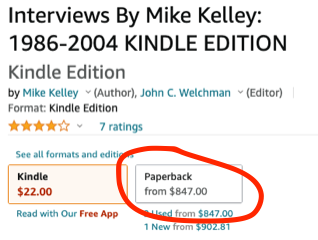
No, poets. Mike Kelley and Jim Shaw had an $847 conversation:
Mike Kelley names Shaw’s strategies: “you use flows of imagery in your work, whether you want to talk about it through narrative issues, or associative flow, or formal connections… or whatever.”Shaw answers: “I wanted to do a visual version of William Burroughs’ fractured style and make reference to a wide variety of things…” He cites the paintings of James Rosenquist, which, Shaw replies, “present a collage of popular imagery, but are unified by his… painting manner.”
A few words later, Kelley makes the point that Shaw works, in fact, with “stylistic disunity”
And Shaw talks about becoming tired with the restrictions of series and wanting to work with his own feelings of getting bored before it started to get boring: “I would start off with simple distortions and then then become more convoluted and weird; they would end up really fragmented.”
How does your poem flow? Through narrative, association, formality? What exactly is flowing?
Shaw talks elsewhere of thinking up various “excuses to render” because he likes to draw. Are there tropes or techniques you want to fit into your work all the time? Maybe places or times you want to write about? Does your comfort with these things provide a safety net for your other poetic moves?
What unifies your work? Or, are you, like Shaw, drawn to disunity? Can you put the force which wants to disrupt your unity into your work, thereby creating a more inclusive whole?
Frank Rubino’s letter of invitation and inspiration to the weekly Red Wheelbarrow Poets’ Workshop of May 25, 2021
Hi Everybody-
Arthur Russel publishes Field Notes from our workshop on a fairly regular (almost never misses) weekly schedule. These notes are a view into how poets work and how poets talk about poets’ work. They’re a wonderful anthology but this week Arthur didn’t get to it because of me. See, in our interdependent community, Arthur needs me to package the poems up in a pdf and send them to him, which I usually do right after the workshop, or else I forget, like I did this week. In a poetry community we have little paper clip chains of helpfulness that add up to our literary history. It’s how art gets done.
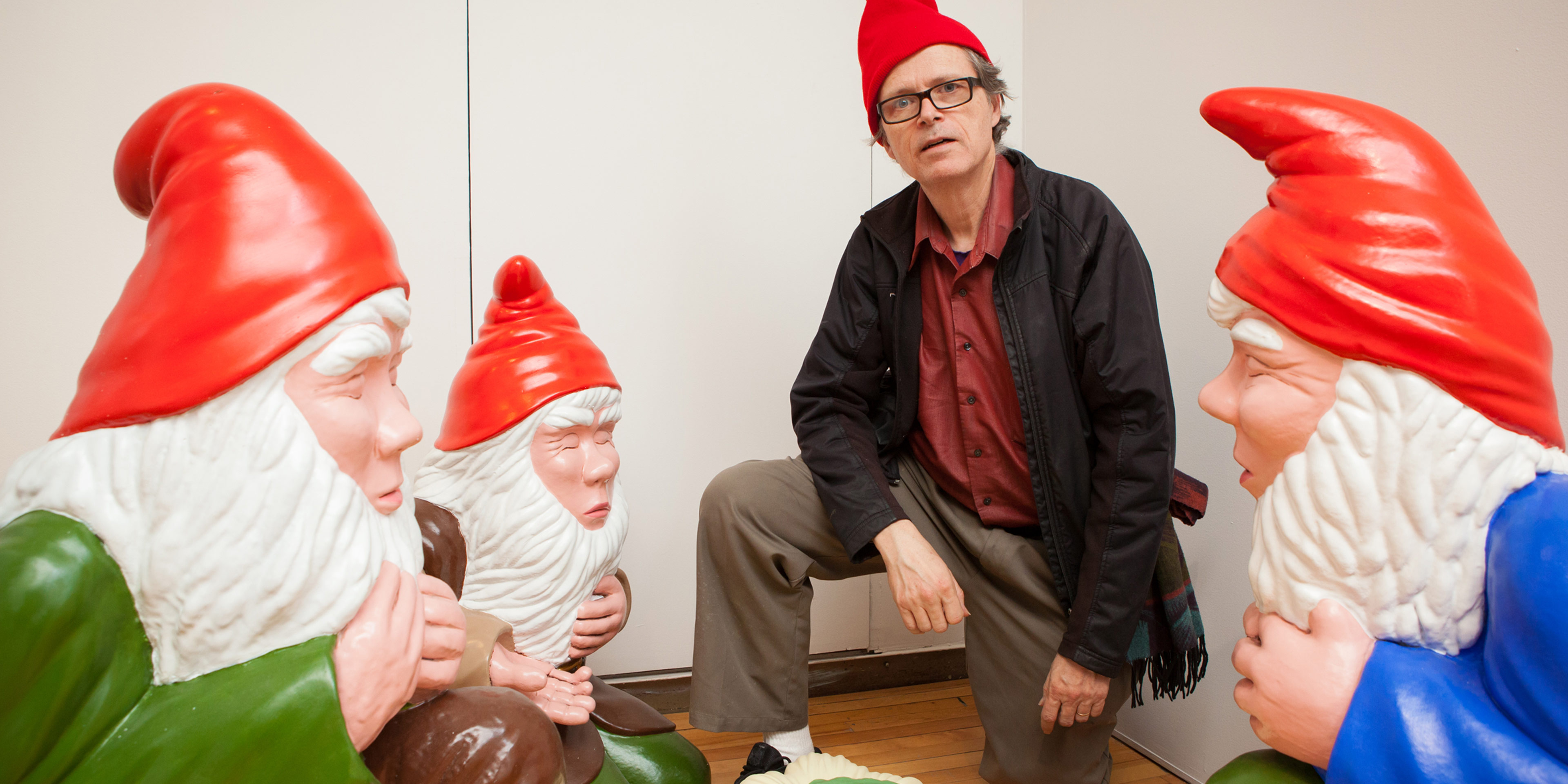
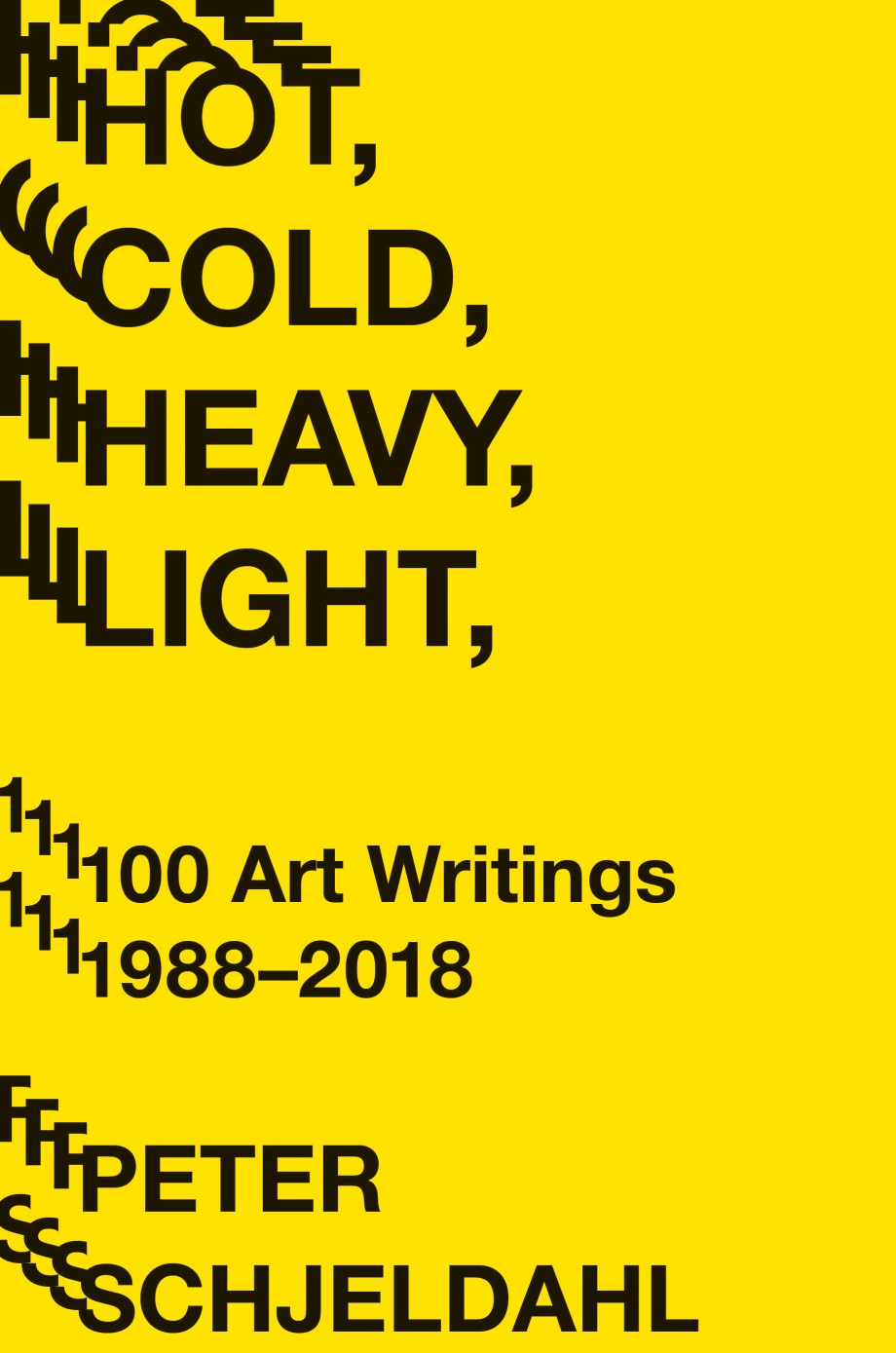
It reminds me of a quote I’ve cited before— in one of my poems— by Peter Schjeldahl, who has written for decades with tireless elegance about the New York art scene. In his collection Hot, Cold, Heavy, Light (https://www.abramsbooks.com/product/hot-cold-heavy-light-100-art-writings-1988-2018_9781683355298/) he talks about Clement Greenberg, the critic whose influence, in the 1950s, raised Abstract Expressionism into preeminence. In his essay on Greenberg, Schjeldahl cites some of Greenberg’s judgements that might seem like mistakes. “Fortunately…” he says, “greatness in or about art has precious little to do with being right. It most involves telling a story that imprints itself, when and while it counts, on the eyes and brains of your contemporaries.”
The connection to our workshop is that we are our contemporaries. We are the ones whose eyes and brains need impressing. We are the ones whose hands carry our work to the readers of the future, but we count now. Please don’t be embarrassed to say you’re coming to our workshop to be great.
I’m the kind of person who would automatically sneer at such an idea. However I am then left with very little explanation as to why I keep trying to write better poems.
Schjeldahl might say great poems can imprint themselves. How? Once poems inspired memorization. I don’t think that’s so widespread now.
Who are your contemporaries? What matters to them? How will you get their attention? I’m one of your contemporaries.
Frank Rubino’s letter of invitation and inspiration to the weekly Red Wheelbarrow Poets’ Workshop of May 18, 2021
Hi Everybody-
As a follow on to last week’s alexithymia letter I want to write to you this week citing an album I’ve had on heavy rotation: John Lennon’s Plastic Ono Band ( https://open.spotify.com/album/0nYrjKixKaREskGL449EqU )
This album was made in 1970, just after the Beatles broke up. A deluxe edition that came out this year includes multiple takes of each track, showing Lennon’s process as he refined its raw impact.
I include it as counterpoint to alexithymia because it famously employs primal scream (https://en.wikipedia.org/wiki/Primal_therapy ) and uses personal trauma for its sources. Remember alexithymia’s experience:
Difficulty identifying different types of feelings
Limited understanding of what causes feelings
Difficulty expressing feelings
Difficulty recognizing facial cues in others
Limited or rigid imagination
Constricted style of thinking
Hypersensitive to physical sensations
Detached or tentative connection to others
Plastic Ono Band today sounds so real, so urgent, and so pained. In composing it, John Lennon worked with feelings of betrayal and abandonment: its minimal, three piece settings propel, announce, insist. Feelings are central: the songs are hot. They renounce the singer’s idols (one of whom happens to have been himself) and strive for a more humane, reality-based conception of being alive. I recall when I first bought a copy of this album to hear Working Class Hero, with its notorious word ‘fuck’ and played it during dinner to bug my parents. In my recent listening, I’ve become fascinated by the word “Cookie,” whose use in take after take of Hold On testifies to how Lennon valued a ‘casual’ or ’throwaway’ endearment. As the original teen-aged listener, I was embarrassed by the vulnerability of that aside. Now I think vulnerability is real, and real is poems.
When you are writing a poem, are you vulnerable? What’s your “Cookie?”
It’s like John Lennon read last week’s prompt before he wrote Plastic Ono Band’s lyrics: “I have alexithymia:” Take each bullet point in the above list and elaborate.
This album has enriched my life so much in the past couple of weeks, in part because it enriched my life as a High Schooler, and it makes a prism between then-me and now-me. Do you use your poems as time-traveling mirrors?
Critics complained of Plastic Ono Band’s emphasis on self-expression. As a High Schooler, I was inclined to agree, even as I memorized the album. Today, I think the critics were blind. Have you reclaimed anything that was uncomfortable for you?
Arthur Russell‘s recap of The Red Wheelbarrow Poets’ Workshop of May 25, 2021
We had a super workshop on Tuesday, May 25; sixteen people, and we got to nine fantastic poems, with six held over to next Tuesday.
Preeti Shah, our friend from Brooklyn Poets, brought a poem (her first with us) called “The Timing of Things”—a meditative lyrical narrative apostrophe on finding a small bird, dead from a fall, outside a CVS, and the revisionist dream born in the grief at seeing it (we’ve all had one like it, admit it) of having arrived just in the nick of time to catch it. Addressing the bird, she writes: “Perhaps a few hours earlier,/ I could have broken your fall/ by stretching my cotton ribbed shirt/ widely as a safety net…” However, the poem turns sharply from that fantasy, to extended lyrical images of the corpse and its disintegration: “Your dust-strewn feathers/ have blown across/ the empty parking lot/ passed the cigarette butts, to the far side/ of cracked cement/ where pedestrians wait to cross.” A poem full of a deep, innocent regret. Thank you, Preeti. Tom Benediktsson commented on Frank Rubino‘s poem “My kid confesses twenty years of crime” that this like other recent ones (I’d say the last six weeks) have used a lot of cantorial repetition, to give a lyric voice to his poems. Frank’s poems always honor his compositional intuitions, and the consequent veering can sometimes challenge the reader (intentionally or not). The rhetorical power of the anphora does a lot of work to hold them together, at least that seems to be what the experiment is, and that Tom noticed and that I agree with. This week’s poem is about the rent fabric of a family when one of the children, as the title suggests, confesses to twenty years of crime. The poem features several repeated phrases, “she stole… she stole… she stole” “She doesn’t know… She doesn’t know” and “Kids don’t know. . . Kids don’t know” which home in on the obsessional difficulty accepting the disaster while exposing the speaker’s strategies to avoid the tragedy. Elsewhere the anaphora adopts the cadence of an old English judgment with a stanza that includes “For having lived a life of crime & for to heal her spirit,/ & for to repair her thousand injuries…/ she must leave our house forthwith.” Still elsewhere, Frank nearly pauses the poem to say: “Well well well/ Oh well.” For me, the central image that repeated in all the sections, that time is the glue of suffering, was too complex to thaw and resolve itself into a dew, but I have faith it will do in the next drafts.
Brendan McEntee‘s great/wonderful poem, “Thanksgiving Walk,” was a mood poem, in which the careful examination of the world outside reflects the inner mood of the speaker; and as Tom said, the poem had a speaker, but no “I” which made it more purely a mirror. Here’s the second stanza entire:
Squint-visible in low tide stink, barely legible on the swollen log under the seaweed cling: “YOU are the means of production.”
Someone went through a lot of work for subtle abjection.
John J Trause crazily surmised that the “squint” and the “stink” were intentionally set in place to create the sonic echo of “squid ink”-as the medium in which the message was written on the swollen log. And even more crazily, Brendan agreed! Personally, I loved “Squint-visible” as a compound adjective and the tetrameter cadence of the stanza through its first four lines.
Bridget Sprouls‘ poem “Swati’s Daughter, Radha” was a blessing for the girl, Radha. The specific blessings varied from the surreal to the practical, and at the end the power of the ballad meter asserted itself. Lovely poem.
My own poem, “Peonies” was a four-stanza lyric on lost love written in ballad meter, inspired by my recent study of Emily Dickinson, who wrote in that meter frequently. Don Zirilli said that the poem embraced its formality, and Frank noticed the ‘archaic’ structure of its phases; Benediktsson said it was in conversation with older poems such as Houseman’s “Shropshire Lad.” And Don said that the metaphysics of the second stanza, where the speaker sees his lost love in “an iridescent grackle wing,/ the sun’s reflection on a rake/ or any other holy thing” went further back, to John Donne, Janet K’s summed it all up as follows – “This poem cries out for an Irish folksinger.”
Jen Poteet wrote a poem about the disrespect that people show to people who lose their cats. The title says it all: “Get Another One!” The drippingest sarcasm came in the line some thought it should end on: “They’ve got a slew of hardy plants/ down at the Home Depot…”
Don Zirilli‘s poem, “Diagnosis” about an existential crisis, had the droll absurdism of an early Woody Allen stand-up (“My mother made me a homosexual, and if you get her the yarn, she’ll make you one too”), with a side order of surreal madness. Frank and I thought it was painfully funny; others didn’t see the humor, just the pain. This pleased Don. Lines like “I’m a Stage IV auto-empath.” and “Maybe I’ve put your finger right on it” and “I come from a long line of mouth eaters” point in one way. Others like “The house is burning right now,/ in the wall somewhere,/ and all I can think about is pop tarts.” veer towards a genuine crisis, while the last couplet demonstrates anguish, still laced with absurdism: “I hope I’ve answered your question and I really really/ hope you asked one.”
Moira‘s moving-day poem, “Backwards Glance” got a ton of respect for its leisurely pace associated with a last look at a long-lived home. It’s a list poem that only slowly reveals its situation, beginning with “The birds, the squirrels and their/nutshell calling cards” then continues to inventory the world outside (similarly but differently from Brendan’s “Thanksgiving Walk”) with a line that starts out at a canter and then ignites: “A warm breeze, a cool breeze,/ the burning bush.” But the poem really ignites when it comes inside: “Eggs over easy/ Your spice rub./ The refrigerator, the stove, the oven/ The Weber kettle barbecue// Your underwear drawer brimming with boxers./ T-shirts worn to threadbare softness/ which I now wear as nightshirts// As I sit on the deck bathed in the light and warmth/ of a late afternoon sun,/ its hard to stay/ and hard to leave.” These completely unvarnished items have so much power that adjectives would add nothing.
Ana Doina‘s “Gagarin’s radishes” was widely viewed as a prose piece, or a short story, rather than a poem, probably because the story was memorable, but the writing was not necessarily. Either way, the conjunction of children in Russia in the later 1950s helping a neighbor harvest her radishes in exchange for sandwiches with radish, butter and salt, and the first Soviet cosmonaut, Yuri Gagarin was irresistible.
So that’s the end of the field notes for May 25, 2021. I’m going to be absent from the workshop for the next six weeks because I’m going to be in a workshop Tuesday evenings as part of a yearlong mentorship program I’m enrolled in through Brooklyn Poets. See you when that’s done, mid July. Be nice to Frank. He’s a great guy.



 The Red Wheelbarrow Poets
You must be logged in to post a comment.