Field Notes, Week of 12-15-20

Arthur Russell‘s recap of The Red Wheelbarrow Poets’ Workshop of 
December 15, 2020

It was a workshop popping at the seams with new ideas, revisions, rough drafts and final versions.  And we kept to our time: 7-9.  No one wants to be the last poem discussed at a three hour workshop. Please remember to put your name on the top of your poem before you upload it, and where possible, make it single spaced (except stanza breaks) so we can all see it on the screen without too much scrolling.  Also, if anyone has Yana’s email, send it and I’ll add her to the list.

Yana brought a poem called  “Lullaby” that was addressed to and incorporated the lyrics of a Russian lullaby into a poem that examines and amplifies its dreadful message: “the grey wolfie will come/ seize you by your little side/ and drag you into the forest.”  Claudia liked the beginning where the lullaby lyrics were interlineated with its analysis.  Tom noted a shift in the language in the stanza starting “Would the fanged jaws tear your flesh” from something simple and lullaby-ish to something else.   Don disagreed, thinks the language is all consistent.  And there were a few other comments for pruning and rearranging, but no one addressed the underlying problem, which is how the hell are we supposed to go to sleep tonight?

Tom Benedicktsson‘s “Scratch” was a flight of scientific hypothesis comparing the survival tactics used by slime mold with those employed by yeasts, their evolutionary “cousins.”  It was arresting, original and very funny, especially the bits about yeast, where the references were to well known yeast hanghouts like  “drunken orgies” and “tearful bread-baking melodramas as well as the true sounding, but inexplicable “bottoms of poets.”  Not nearly as terrifying as Yana’s WOLFIES, but potentially more imminent.

Susanna Lee‘s poem, an early draft, she says, “Turkey Dinner Poetry,” also took on the lives of poets, in a different manner. She analyzed the preparation and service of Thanksgiving dinner under the rubrics of a poetry workshop: examining the stanzas, the ‘meat’ of the poem, and the editing process.  A meta-poetical discussion broke out over the use of the word “shard” to describe the bone fragment that has choked many attendees at one of these dinners.  Some thought it had too much Greek pottery in it.  Someone even cited to a supposed a poetry nostrum: “don’t use the word ‘shard’ in a poem.”  (That was a new one on me.  I’d been advised that “soul” and “azure” were declasse, but ‘shard’ is so useful if you need a rhyme with “lard.”)  But Tom like “shard” so Susanna was left to work it out on her own.  Finally, someone got up the courage to tell her to ditch the poetry metaphor completely and perhaps focus more on the racist rants of ratched uncles, and the secrets unintentionally spilled by sloppy sherry sipping aunts.  

Shane Wagner brought one of last night’s successful revisions, his poem “Past Lovers.”  Last week we urged him to get down into the the weeds of these ‘what if’ ladies, and he delivered.  Using “I go back to past lovers” as an anaphoric summoner, he details three of these episodes, and what was nice was how the poem deepened in emotional resonance as the degree of sexual involvement deepened (my mom told me that would happen).  But getting down in the weeds also introduced the tangles of those trysts which, as we all know, can resist the compression poetry adores.  While the hookup in the ’76 Civic only raised general questions (“If I lingered … do we marry … do I work for your father .. how long have we been divorced”) the groping session in the ’78 Accord (which has a more spacious interior that the Civic) raised questions of consent (“why did you stop us, put on all of your clothes…?) and the third adventure there’s an abbreviated romantic comedy “meet cute” on a railroad platform followed by the pair becoming lovers who only split when “you” went to Providence and “I” didn’t follow.  So much to manage, and yet, if Shane pulls it off, we’ll get Tom Hanks to play him.

Ray Turco was back with another free-verse tale of an Italian hero, this one “Giorgio Perlasca” who played a role in saving Jews from concentration camps in WWII.  And while Don said the brevity of this piece was powerful, and Janet was a little confused by the ruse Giorgio used, the most interesting part of the discussion, I think, was what role the prose footnotes that Ray adds to the bottom of these poems play.  The prose notes provide a short biography of the heroes.  Carol, voicing a concern that resonates with mid-20th Century poets who insist that the poem can and should speak for itself, asked Why?  There are other traditions, however, in which the poem includes an “argument” that introduces the lyrical content (see Milton’s Elegy “Lycidas” for example), and editors frequently seek to ease the reader’s entry to the poem’s universe with explanatory marginalia and footnotes, and there are truckloads of poetry books today that come with fucking interminable endnotes.  Our own Mark Fogarty frequently uses footnotes to provide context for his historical and sports pieces.  So then there was a debate as to whether Ray should put his biographical data in a footnote as he does or in an endnote.  That discussion has now made it into these field notes, which can be referenced by future editors of Ray’s collected poems.

Speaking of Fogarty, he brought a fart poem: “The Wedding Party,” about the speaker and “Jack Sheridan” using their Christmas gift reel-to-reel tape recorders, to perform a fart compendium to rival the ethnological work of Alan Lomax.  There came a moment in this conversation where John J Trause, who has known Fogarty for fifteen years, asked Fogarty to explain why he capitalizes the first letter of each line of his poems.  Fogarty sighed deeply.

And then it was Trause‘s turn.  He brought a triolet (look it up) called “Procrastination” that considers the his career as a writer of sestinas.  It was roundly loved.

Jen Poteet brought back her poem from last week, one of her emerging collection of poems about hanging out in the present day with dead poets.  (Like trading cards, she’s already got nearly a full set).  This rewrite was hugely successful because instead of merely placing the poet in a modern situation (So-and-so on Instagram, for example) and them mimicking the style of the dearly departed, this audacious piece brought Mary Oliver back to life so that she and Jen could feed the ducks at Race Point.  And, truly in the tradition of Ginsberg’s “Supermarket in California” or, more recently Jason Koo’s “Shopping with Mayakovsky” (recently reissued in Man on an Extremely Small Island by Brooklyn Arts Press), the two of them talk, and in that moment, however briefly, that dialogue with our teachers and forbears springs into life.
Barbara Hall brought a poem called “Butterflies and eyes” appears at first to be about a friend who doesn’t take care of herself and lies a lot about it, but also about the sense of frustration the speaker feels with this friend, and finally, as Don Z pointed out, asks what this poem says about the speaker who is constantly passing judgment on her friend.”  And, Don added, if that’s the point, it needs to be brought out more.

Don‘s poem, “QAnon,” raised a bunch of perspectival issues itself.  Directed at the movement devoted to spreading destabilizing lies about everything from politics to child abduction and sex trafficking by Hillary Clinton (i.e., politics), the poem didn’t clearly announce whether it was in the voice of a QAnonamist, or a highly sarcastic critic of the movement.  Claudia said the voice of the poem — with its aphorisms (“Truth is the shovel, not the snow.”) — was very detached and she couldn’t relate to it.  Ray thought the speaker was complicit in the lies.  Yana said that the whole thing was “very disturbing,” and remarked on its lack of compassion or sympathy.  Tom said: deeply cynical.  Don said: “Thanks!”

Claudia Serea, as she is wont to do, brought a masterpiece called “The year we stayed home,” which announces at the beginning that it’s willing to go for the surreal:  “It was the year when I built you a house of clouds/ and filled it with thunderclaps and summer rain,/ so you can sleep well at night.”  The poem turns out to need its full artillery of imagery to shepherd us through a difficult time in the relation between the speaker, a mother, and the “you” of the poem, a daughter:  “It was the year when you wrecked your body,/ and I built a house of screams/ in which you wailed and hated me.”  But my favorite line was not surreal at all: “the year we cried/ on both sides of the bathroom door.”  

The elegy as a poetic form has a few traditional directions it can go, mourning the loss, cursing the fates, bringing the lost ones back to life, tying their death to larger sociological problems or issues, or using the moment to reflect on what was unique about the deceased.  Carole Stone‘s poem “Town” addressed the death of a friend named Ruth, with the elegiacal force of memory and dread:  “Soon no one of our generation will be left./ Each day I’m a little sadder,” she wrote, and in a downbeat manner recalled how they met and the last time they saw one another.  

Janet K brought a poem called “Rhizome” that celebrated the newly discovered scientific evidence that trees communicate with one another through their roots.  Where the poem got controversial, however, was where the speaker compares the peace-loving trees to the awful habits of humanity.  This, according to Don Z, made her poem into a bit of a Joyce Kilmer “Trees”.

My poem “Exile’s Letter” is an imitation of Ezra Pound’s “translation” (boy oh boy, is that a controversial word in this context) of Li Po’s poem of the same name.  We didn’t get to work on it last night, and it’s kind of long, so maybe we can talk about it next week without two readings, as has become our norm. 

—Arthur Russell

Field Notes, Week of 12-1-20

Arthur Russell‘s recap of The Red Wheelbarrow Poets’ Workshop of 
December 1, 2020

Arthur Russell, and sometimes Frank Rubino and others, have been sending the weekly Field Notes to our workshop fans in an email for several years, but only this week we decided to archive them online on our web site. These workshop notes are a treasure trove of poetic knowledge and a way to catalog our work, week to week. We hope you’ll enjoy this new feature.

————————————————————————————

Can I just say, it was a great week for RWB. We had an awesome hard-working (and very efficient) workshop on Tuesday, and then an RWB reading on Wednesday with Susanna Rich as the feature and one of the best open mics we’ve ever had: the range of work we heard was arms spread wide.

Of the workshop, I’ll report this:

For a little gem, Moira O brought a poem called “Slice” that, like Sylvia Plath’s “Cut” turned a kitchen accident into poetic gold.  The first line, zeroing in on the shape of the knife’s impression, tells you everything you need to know about how poetry sees things newly:  “It smiles back at me/ with a baby’s toothless grin.”   As usual with a short, good poem, the conversation was intense and joyous.

Also in the realm of short poems, was Susanna Lee’s poem “The Quitter,” about a “last cigarette.”  (On that subject I strongly recommend Italo Svevo’s novel, Confessions of Zeno). In just a few lines, Susanna captured the firmness as well as the contingent nature of any claim to finality when it comes to quitting smoking:  “stubbing out the cigarette/ twisting, twisting it out, into the ashtray// gently dropping, into the pile of ash/ the very last butt, ever// the wry smile.  

Interesting, isn’t it, how the baby’s toothless grin (Moira) and the wry smile of the quitter (Susanna) function so well as images.

Don’s poem, “Sean Connery vs. Watson” had everything a good Zirilli poem needs: a reference to media, a persona to carry the message, and an ironic pose.  This one, a rant in Sean Connery’s voice, riffs on the Jeopardy tv game show (which is where IBM chose to introduce its IA product, “Watson”), as well as a Saturday Night Live sketch involving Sean Connery (who never appeared on Jeopardy), and touches on a theme Don visits regularly: computers vs. humans.  In Don’s poem, the Jeopardy question that breaks Watson’s back is to name the best Bond movie.

(In our workshop, recently we’ve been having the poems read more than once, which is fantastic for giving us all a chance to let the poem sink in before we start tearing it apart, and also to let the poet hear the poem in someone else’s voice, which can be the most important feedback of all.  Don nominated Brendan to read this poem, and Brendan did an outstanding imitation of Sean Connery’s voice, which really brought the poem to life.  Read it in that voice, and you’ll laugh too.)

In an almost alarming way, Don’s poem pairs well with Tom Benediktsson’s called “Trivia, Roman Goddess of Graveyards and Crossroads” which also turns on a point of cinematic greatness: a charge to name “the thirteen films of Preston Sturges.”  Unlike Don’s, written in a Scottish accent, Tom’s poem feature’s his cinematic penchant for macabre.  He creates a graveyard scene that is both Anglo Saxon (hackle) and Roman (greaves) in its feel, with a goddess who speaks like “broken glass in a tin bucket.” She denies the traveler permission to pass unless they can answer about Sturges. 

And since we’re going to the movies, we should talk about Frank Rubino’s excellent poem, “I, Popcorn,” which really has nothing to do with movie trivia.  It concerns itself with being “so small in all this,” ‘this’ being life, and it shows us both his trip to Russia to adopt (‘find’) his daughter, and his father’s volunteer work in a hospice for homeless AIDS sufferers (where he made popcorn for movie nights), and the speaker’s own beginnings as a zygote.  Frank’s strong suit – his go to – is unflinchingly and verbatim at times to depict his quotidian life – “My daughter drops into the sofa …/ chewing her peanut butter/ on ‘Dave’s Powergrain bread with oat kernals,’”  in the belief that the details will anchor his meditations.  By the way, you’ve gotta love getting ‘zygote’ into a poem (with 10 Scrabble points for the ‘z’, 4 for the ‘y’ and 2 for the ‘g’, if you could land that on a triple words score square, you’d have 57 points, and potentially end the game right there.

My own poem, “Cloisters,” as Ray Turco noted, “captures a common moment well” – the moment when a child learns that their parents will one day die.  This early draft needed workshopping and got a lot of help in terms of the diction, the register, and even the title (Jen Poteet shook her head sadly when she said “not so good.”).

Jen’s poem, “Amy Lowell’s Instagram Post” continued her current series of poems about dead poets brought back to life in today’s world.    Don said it evokes Amy Lowell very well and that Instagram is a great connection for Amy Lowell; Tom said Jen’s was better than Amy Lowell (beating up on Amy Lowell is a spectator sport in some countries), Ray T wondered if the poem could connect more to the style of Instagram, and I said the poem doesn’t really connect Amy Lowell to the present except in the title.  Rumor is Jen’s been working on it more since then.

Welcome back to Paul Leibow, who brought Afraid of the Dark Volumes I and 2.  We discussed only Volume 1.  It is similar to some of Paul’s other work that juxtaposes human cruelty to animal behavior as seen on nature shows, and as such functions as a biting indictment of humanity (biting indictments of humanity, am I right?).

“Deathbed Wisdom” by Brendan M, is a lyric that invades the hospital room of a dying woman, whose final memories are depicted in two lines beginning “Once, she’d”, and whose death is depicted indirectly, by reference to the machines that record her vital signs (“The electric impulse of her stutters, fails.”) and a strange, lovely euphemism for her passing (“Her body sighs”).  The group was impressed with its nuance and overall feeling.

Ray Turco brought poem Number 32 in his advancing collection of Italian mostly war heroes , this one called “Pietor Micca” which tells the story of  a soldier in the army of the Duchy of Savor.  There was abundant praise for this poem in the tightness of the narrative and strong line endings, but some suggestions about repetitions of words that didn’t bring new meaning to them, and isn’t that the nut at the heart of repetition in poetry.  Words carry their historical allusions into a poem, where they gather new and expanded meaning peculiar to the scene.  When a poem uses a word over and over, the word needs to do new work, not just in terms of meaning, but also rhetorical or metrical work.

And speaking of repetition in poems, John J Trause’s poem “Incestina” was a sestina that played with one of the scenes from Vladimir Nabokov’s Lolita.  His six repeating words (as required by the form) were “daughter” “improper” “nymphet” “crossroads” “village” and “Dolores” (Frank liked those), so, even if you didn’t know the scene from the book to which John referred, everyone understood the overall reference.  Don said he enjoyed the quixotic project of the poem since in some sense it’s ridiculous to make a sestina from Lolita, but Tom B made the observation that for all of the obvious and clever resonances, the poem lacked a “narrative line” but simply repeated the same situation.  In his comments at the end of the discussion, JJT pointed out that he had varied the word order of a classical sestina in the last stanza, using the order that Auden, who is generally considered to have revived the use of the sestina in English had used in his (Pasage Moralise?). 

Janet Kolstein is always writing about art, and in “Il Divino” she considers dirt.  The poem starts with a kind of catalog of all the cleaning of ourselves we people do, and this first part ends by referring to our bodies as a “pristine chapel” – which is a glorious rhyme (for Sistine Chapel) that sends her in the direction of Il Divino, one of the nicknames for Michelangelo, the great Italian artist (1475-1564).  And the second stanza of Janet’s poem notes that “there was no time for hygiene” in Michelangelo’s work, neither in his depiction of the biblical characters nor in the “corpses/ he bought for dissection.”  It’s kind of a “why so prissy” poem, but not all the way to an indictment of humanity. 

Barbara Hall brought a lyric poem called “The Birds” (sorry, no copy available), which talked about pain through loss in childbirth, loss of two husbands, a father and brother dying and used the images of birds in an “almost biblical” way (Moira) to capture and make tolerable the pain.

Can’t end these notes without a reference to the amazing open mic at the “Williams Center Virtual Reading for December 2, 2020”   We had Mark F reading his amazing “Lunch at the Titi Hut,” Maria Lisella reading a stunning poem called “My Junk” about an argument she continues to have with her deceased husband about the stuff in their Queens apartment, Davidson Garret’s heart crushing poem going back to the AIDs epidemic called “Death in a Harlem Hospital with Straussian Overtones, December 1, 1996”, Joel Allegretti’s amazing ideogram of a poem called “Meditations in Red”, Susanna Lee’s multiply-rewritten and nuanced “Social Distancing With the Ladies”, and Frank Rubino’s excellent poem about being a young man finding his legs in the New York social scene in the 1970s called “Helena’s). Those are only some of the highlights of a super wonderful reading.  Everything rang true, and there’s no higher praise for a poetry reading than that. 

See you all in black and white!

—Arthur Russell

Williams Readings on Zoom—Susanna Rich—Dec 2

Join us on Wednesday, December 2, 2020 at 7 p.m. to hear the poet and performer Susanna Rich read from her work. Please come early and wait in the waiting room for the host to let you in.

Susanna Rich is a bilingual Hungarian-American, Fulbright Fellow in Creative Writing, and Collegium Budapest Fellow—with roots in Transylvania and family ties to the vampire known as the Blood Countess, Elizabeth Báthory. Susanna is an Emmy-Award nominee, and the founding producer and principal performer at Wild Nights Productions, LLC. Her repertoire includes the musical Shakespeare’s *itches: The Women v. Will and ashes, ashes: A Poet Responds to the Shoah. She is author of five poetry collections, Beware the House, Television Daddy, The Drive Home, Surfing for Jesus; and, in celebration of the centennial of the 19th Amendment, recognizing the right of United States women to vote, SHOUT! Poetry for Suffrage. Visit Susanna at www.wildnightsproductions.com.

Tune in to listen to poignant poetry and participate in the open mic. NJ’s best and most vibrant reading series is alive and well on Zoom!

Please see instructions below. To avoid issues at the reading, please don’t share the Zoom link on Facebook. We are instructing people who want to attend to DM Claudia, Don, Arthur, or Anton to get the link.

Zoom instructions:
If you’ve never tried Zoom, please download it from zoom.com and get familiar with it. It’s pretty simple, and tons of people use it. If you have the zoom application but haven’t used it in a while, it’s not a bad idea to upgrade it to the latest version.Please note:
1. The meeting has a waiting room. Please come early and wait in the waiting room for the host to let you in.
2. People can’t join before the host. Our host on Wednesday, December 2 will be Frank Rubino.
3. To avoid issues at the reading, please don’t share the Zoom link on Facebook.

When you get into the meeting, everyone will go on mute and the MC will kick off with introductions. Use the Chat button to open the Chat panel. For the open mic sign up, we’ll type our names in the Chat panel of the zoom meeting. We will remind you about it at the break. The MC will call off your name from the chat, and you’ll read your poem.

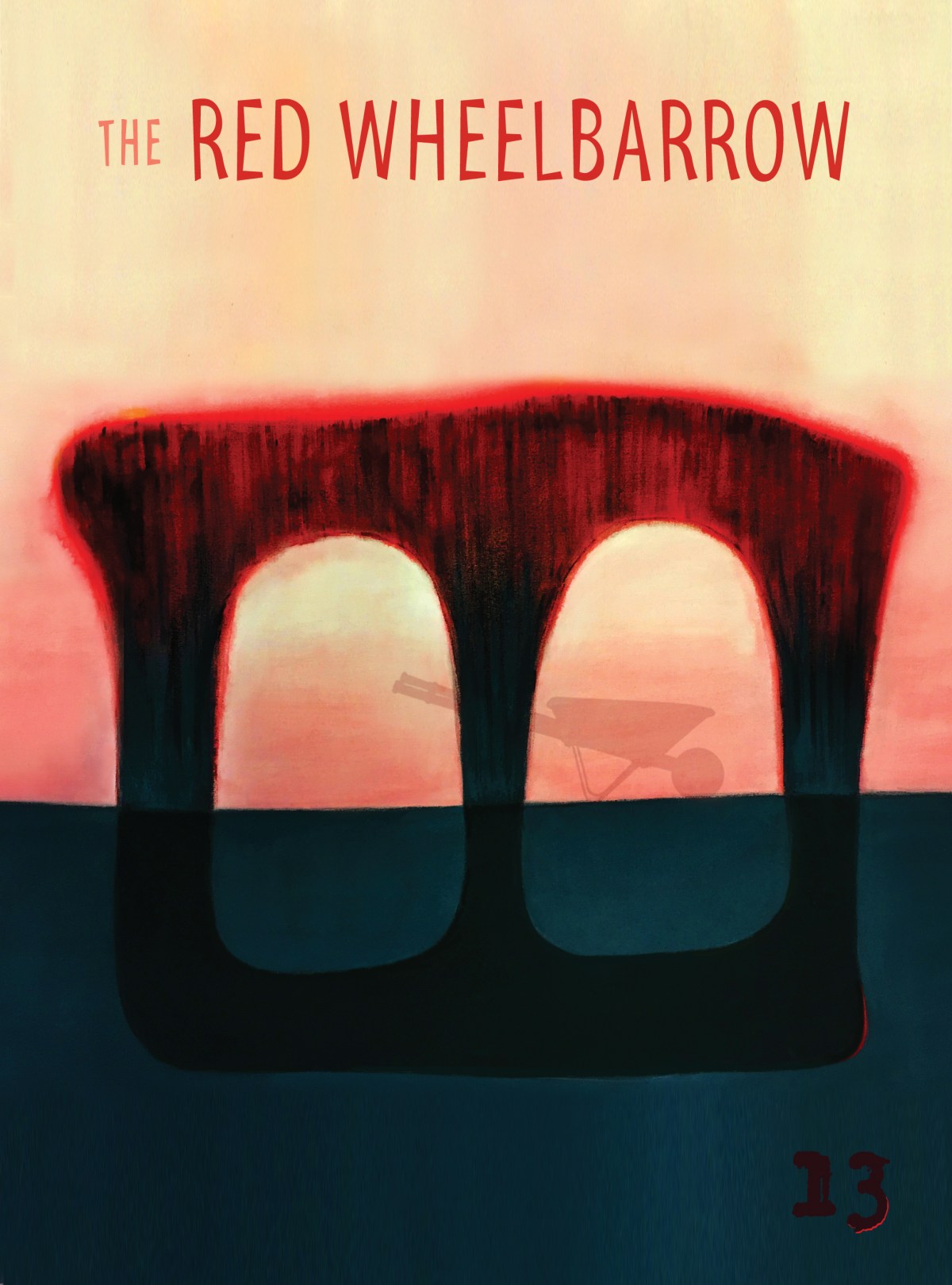
THE RED WHEELBARROW 13 IS HERE!!

The Red Wheelbarrow # 13. Cover art by Paul Leibow.

A POET A WEEK! The year 2020 is going to be remembered for several things, not least of them how we found beauty, meaning and puzzlement and recorded them here, in our lucky 13th Red Wheelbarrow anthology!

Featured poet Zorida Mohammed joins more than 50 other poets pushing The Red Wheelbarrow in the direction of sanity. With 52 poets published here, our prescription for an antidote to a crazy year is to read a poet a week.Mohammed’s poetry looks back on her Caribbean upbringing and the forces that forged her adult life in America as a poet with an uncommonly keen memory and descriptive gift. In addition, we have published a short story that revisits her relationship with her grandfather in Trinidad.

And, after the feature on Mohammed, our lead poet is Rachel Wagner, whose brilliant “Men Follow Me to My Car in the Dark” will ring true to every woman and should be read by every man. Wagner is followed by R. Bremner, whose poem about the thoughts that flashed through his mind while enduring a stroke is instantly memorable. And that’s just the first three poets!

The 13th edition of our RWB is loaded with great poetry, essays and artwork, including the expressive line drawing doodles of Donald Zirilli and the hopeful cover art by Paul Leibow, “Women’s Future,” underlining the themes of the nearly two dozen women poets published here.

Get ready for some great literary adventures. You’ll find within these pages the vengeful nature of Osage oranges (Susanna Lee), the story of a hunchback right out of New York Gothic (Ken Vennette) and a mini-epic merging the stories of Hiawatha, the Last of the Mohicans, and a modern-day immigrant to New York City (Petraq Risto).

That poem, and the book, ends with Michelangelo’s finger of God pointing at the Statue of Liberty, a grand image to put up against a year filled with disasters. We also add a tribute or two to our retiring founding editor, Jim Klein, who it has been my privilege to succeed. The intelligence and energy of our one-a-week poets show that this anthology has a great future as well as an illustrious past.
—MARK FOGARTY, Editor

To order:
https://www.lulu.com/en/us/shop/mark-fogarty/the-red-wheelbarrow-13/paperback/product-4jqj8n.html

Type ORDER10 into the discount code box on checkout to get 10% off through September 18!

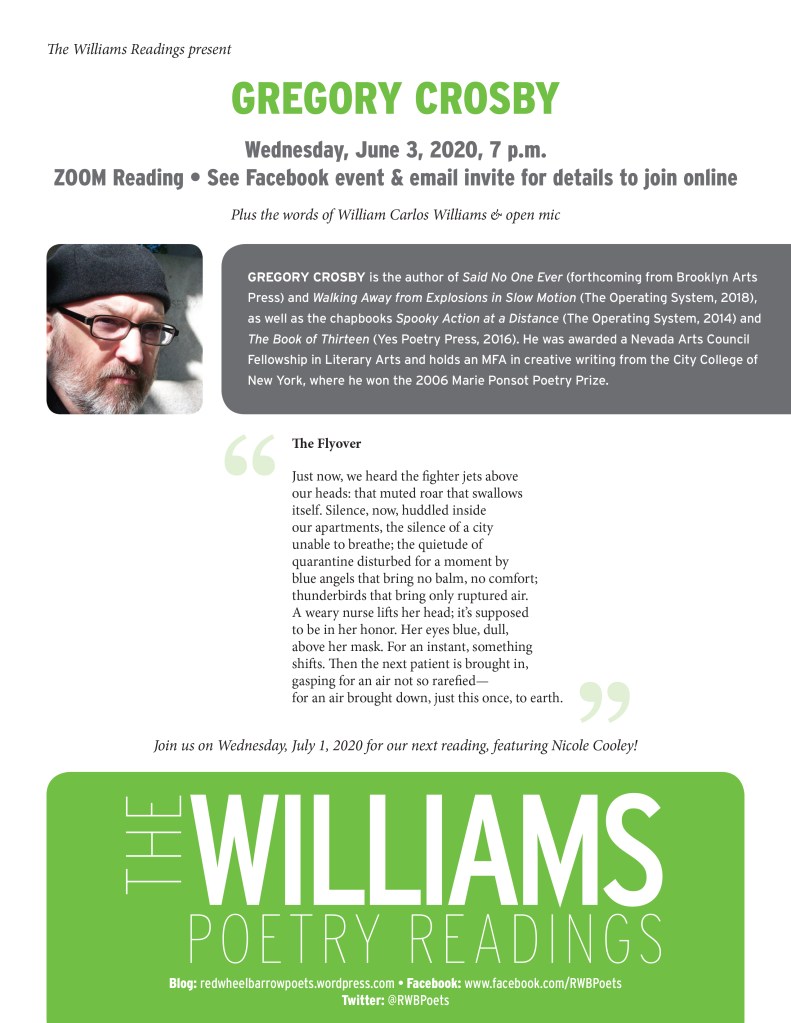
WCW on Zoom—Gregory Crosby—June 3

You are cordially invited to join us on Wednesday, June 3rd at 7:00 pm for our virtual Williams poetry reading on Zoom. Our featured poet will be Gregory Crosby, a noted Brooklyn poet.

Tune in to listen to his poignant poetry and participate in the open mic. NJ’s best and most vibrant reading series is alive and well on Zoom!

Instructions are given below on how to access our reading on Zoom. Much thanks to Frank Rubino for setting up our virtual reading and making it all possible.

We’ll see you all online on June 3rd at 7 pm. Until then, stay safe and be well.

Best Regards,
Claudia Serea
Frank Rubino
Arthur Russell
Anton Yakovlev
Don Zirilli

Zoom instructions:

If you’ve never tried Zoom, please download it from zoom dot com and get familiar with it. It’s pretty simple, and tons of people use it. If you have the zoom program but haven’t used it in a while, it’s not a bad idea to upgrade it to the latest version.

On Wednesday at 7 PM, when the reading starts, you’ll click the link below. You have to click one button for video and another for audio.

https://us02web.zoom.us/j/84557203032
Meeting ID: 845 5720 3032

When you get into the meeting, everyone will go on mute and the MC will kick off with introductions.

Use the Chat button to open the Chat panel.

For the open mike sign up, we’ll type our names in the Chat panel of the zoom meeting. I’ll remind you about it at the break. The MC will call off your name from the chat, and you’ll read your poem.

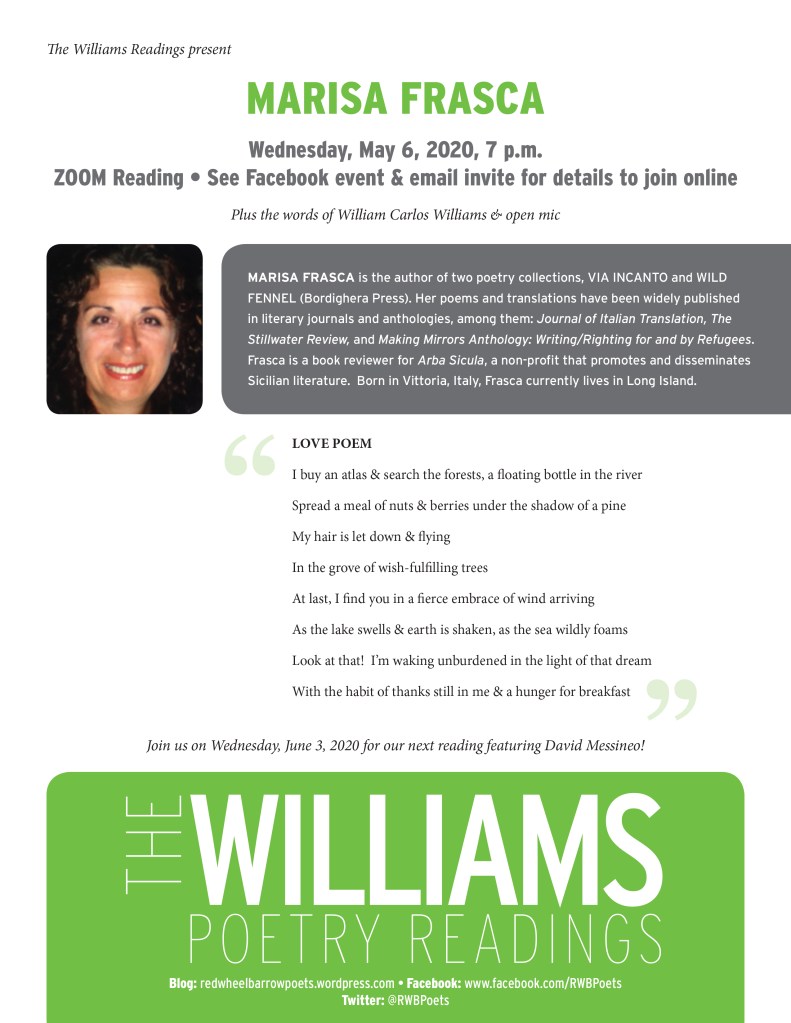
WCW on Zoom—Marisa Frasca—May 6

You are cordially invited to join us on Wednesday, May 6th at 7:00 pm for our first virtual Williams poetry reading on Zoom. Our featured poet will be Marisa Frasca, a very talented and accomplished poet.

Tune in on May 6th to hear Marisa read her passionate and poignant poetry. Participate in the open mic. NJ’s best and most vibrant reading series is alive and well on Zoom!

Instructions are given below on how to access our reading on Zoom.
We’ll see you all online on May 6th at 7 pm. Stay safe and be well.

Best regards,

John Barrale
Frank Rubino
Arthur Russell
Claudia Serea
Anton Yakovlev
Don Zirilli

Zoom instructions:

If you’ve never tried Zoom, please download it from zoom dot com and get familiar with it. It’s pretty simple, and tons of people use it. If you have the zoom program but haven’t used it in a while, it’s not a bad idea to upgrade it to the latest version.

On Wednesday at 7 PM, when the reading starts, you’ll click the link below. You have to click one button for video and another for audio.

https://us02web.zoom.us/j/86162776397
Meeting ID: 861 6277 6397

When you get into the meeting, everyone will go on mute and the MC will kick off with introductions.

Use the Chat button to open the Chat panel. For the open mike sign up, we’ll type our names in the Chat panel of the zoom meeting. I’ll remind you about it at the break. The MC will call off your name from the chat, and you’ll read your poem.

RWB Virtual Workshop—A Deeper Look

The RWB Poets started to hold online workshops on Zoom in an effort to carry on with our writing in time of pandemics. As a new initiative, we’re proposing that one of us will do a short process piece about a poem we workshopped on Tuesday.  Here is this week’s pick, Tom Benediktsson on “Ghosting.”

On “Ghosting”

“Dust.” Image by dre2uomaha0 from Pixabay.

I learned the term “ghosting” two months ago. Duh…not knowing it was a cliché, it seemed like a vivid metaphor. I thought back about times in my life when I ghosted or got ghosted, and then I remembered that dramatic day.

That’s how the poem started, breaking my rule not to write directly from personal experience. Usually I hide behind a speaker I’ve made up– a character, an alter ego. 

While writing the poem I also began to think about “ghosting” as a metaphor for writing. Writing, it occurred to me, can be a kind of “ghosting,” in the sense not of erasing but of inventing someone. Thus writing as that boy I once was is “ghosting.” A ghost writer, of course, is paid to write in someone else’s voice. Maybe all narrative poetry is ghost writing, except of course we don’t get paid. Maybe in all lyric poetry we invent a ghost of ourselves.  

But enough philosophizing. When I revise the poem I’ll drop the three ghosting definitions, for which all of the above was shorthand, and just tell the story, Tom! 

Hmmmm…. who am I when I tell “Tom” what to do?

Ghosting

I’m seventeen. Sitting in a hospital room,
failing to write a paper about Aristotle’s Ethics.
They wheel in my mother, post hysterectomy.
Her snoring stops when a patient shouts out
that the president has been shot.

My mother mumbles.
“Has the president been shot?”
I telephone my father the recluse.
“The president has been shot.”
“To hell with the president how’s your mother!”

I spend the day tending my mother
and checking on the news. That evening,
back at the university, my girlfriend of three weeks
wants to laugh hysterically, wants to dance,
wants me to be that cancelled homecoming date.

She doesn’t ask about the hospital.
I kiss her good night, realize I don’t really like her.
And so I don’t call her again. Ever.
Aristotle might not approve.

Ghosting: abruptly shutting down a relationship.
Ghosting: summoning the dead.
Ghosting: writing as another person.

It’s 57 years. That girl I hurt is a ghost.
That boy I was is another ghost.
My parents, ghosts. The murdered president.
And me

RWB Workshop Poem of the Week—Mar 10, 2020

Janet Kolstein

Conrad Heyer (1749-1856), The Earliest Born Man to be Photographed (in 1852)


He’d heard of the thing
and eyed images born of the contraption.
It wouldn’t take long for his own aged self 
to replicate on the silvered plate.

The man who’d crossed the icy Delaware 
with the Father of Our Country
had orbs reminiscent of the General’s.
His great, beaked nose had grown craggy with years,
his mouth indignant at the loss of teeth.

Maybe, it had been enough to see himself
in the mirror of clear lakes,
or to face his murky reflection on grooming.
He’d looked inward, and knew his character
forged with the gravitas of nationhood.

Changes come to those who live long lives,
some small, some monumental,
some bringing awe and trepidation.
As a farmer, he knew how crops grew from seeds
with the sun and the rain that nurtured his fields,

and that all living things are pitiful
when Death comes calling,
but this new machine, a camera,
miniaturized and memorialized
the very shades of his being,
and, in the beam of his eyes, 
brought forth a new way of seeing
and remembering.

———————————————————————

Blog – http://redwheelbarrowpoets.org
Facebook – https://www.facebook.com/RWBPoets
Twitter – @RWBPoets

RWB Workshop Poem of the Week—Mar 3, 2020

Arthur Russell

Fellatio Salon


I used to think Japanese porn,
with its pixilated penises,
wasted the strengths
that this ethnic type 
perfected,
the ultra femme
squeaky female voices 
no other nationality
could do as well.
Pixilating the cocks,
the coitus, as well the uniquely
directional pubic hair 
of the actors, 
was a shame.

But tonight, I grazed
on a long video
about a sex worker
in a fellatio salon
giving head to five 
guys in forty minutes.
There were no booths.
The guys sat on a pair
of wide banquettes,
both facing the same direction,
waiting their turns
while the others
got sucked off
one at a time.

The sex worker gave 
each of them her full, 
coquettish attention 
for seven or eight minutes.
She started them off
with a bright caress 
of the face, but no kissing.
She’d help them 
get their pants and unders off
then enthuse
as though she’d
spontaneously come up
with the most delightful idea:
oral sex.

She’d entered the room
with a miniature
riding-hood basket
stocked with 
individually wrapped
moistened cloth towelettes
dangling from her fingers.
When she struggled 
to tear the wrapping,
her smile twisted a little.
She’d clean the guy’s groin
before, and again —
more gently —
after he’d come.

She opened 
a second towelette
to wipe her lips 
between patrons.   
What I particularly liked
about her blow jobs
was that she’d
bring a guy off 
in three, four 
minutes tops,
then, after lingering
on the display and swallow
of his cum in her mouth,
which did not appeal to me at all,

she would go back 
to sucking him off
while his dick 
was sagging down 
to limp for nearly 
as long as she had 
on the run up, and, 
for at least one guy,
the second round of sucking
had more impact
than the first.
He turned his head aside and shrieked
into his own shoulder.

The last guy
she blew 
had this cool 
bass baritone grunt,
and a short, thick dick
she seemed to like,
and she made 
a Tootsie pop sound 
each time she popped it 
out of her mouth.
She giggled 
in a slightly more 
delighted way for him
than she had for the others.

All the guys 
were super grateful
and kind of happy,
as though they’d 
just gotten 
a free car wash.
No money
changed hands.
They must’ve
paid outside,
like
a movie ticket.
Inside, they faced forward
and accepted her joy.

The big surprise
for me 
was that after 
the first few minutes, 
I didn’t mind
the pixilated dicks at all.
I didn’t 
need to see 
the lip-on-dick contact.
I could follow
the obvious progression
and read 
the implied emotion
in her courtesan face. 

Pixilated
dicks show modesty.
Her spaghetti-strap 
satin top—
which she hardly 
paid attention to 
for the first 3 guys— 
dropped off
one shoulder for the 
fourth guy. Her tit 
came out, 
but it was an accident.
She lifted it back 
with her thumb.

On the last guy, 
the one with the thick dick
and the baritone grunt,
both straps came off.
Her whole torso,
with its lovely clear
skin and her youth 
intact 
came into view.
You might have caught 
an accidental glimpse of her 
as you walked
past your teenage daughter’s
open bedroom door.

———————————————————————

Blog – http://redwheelbarrowpoets.org
Facebook – https://www.facebook.com/RWBPoets
Twitter – @RWBPoets

RWB Workshop Poem of the Week—Feb 25, 2020

Frank Rubino

We Love Sad Songs
 
I play the songs she listens to over and over.
They help me get into her mind
because those songs are playing in her mind too,
and the voice they take is her voice
inside her thoughts.
 
The voice she hears in the songs in her mind
is resigned to loss.
So much, she hears that voice
that’s sad, that’s yearning to be soothed,
and it makes me think that,
within her private experience,
she feels this yearning, and needs someone
to reach her.
 
Anyone you’re talking to,
anyone you’re standing next to,
or walking up the stairs with,
on their way with you in the meek herd
through the iron passageways
under Penn Station, across the iron gangplanks
hanging over the underground tracks—
anyone with their devices in their ears like networked robots,
all of them, also, have their sad songs.

———————————————————————

Blog – http://redwheelbarrowpoets.org
Facebook – https://www.facebook.com/RWBPoets
Twitter – @RWBPoets