Field Notes, Week of 12-22-20

Arthur Russell‘s recap of The Red Wheelbarrow Poets’ Workshop of 
December 22, 2020

The best dream poems don’t announce themselves as such because that would be like announcing a balloon with a pin.  Like the dreamer, you need to find yourself at the top of a narrow stair before you realize something’s terribly wrong, and that’s what Janet K’s poem, “The Narrow Staircase” did:  “Men in felt hats/ shuffle through the little gate/ that separates the office space,/ and in the time it takes to catch my breath,/ they are whisked up the staircase,/ the dark, narrow staircase.” Is how it starts.  And then comes the inside out part:  “I need to go up the steps;/ I believe I was slated to go up the steps,/ but the faceless woman at the desk/ cannot find my papers,/ and I can’t find the means/ to voice the request.”  And then, at last, in the third stanza, the beginning of the realization: “Something terrible has happened,/ but I cannot fathom what.”  After that, it gets even more complicated, but you’ll have to wait for that because Janet doesn’t like to circulate her poems in the Notes till they’re further along.  She did not say it was a dream of hers, but she did say that it was a death experience.  However, Tom Benediktsson pointed out two excellent qualities of this poem, “no color” and “great verbs.”  And Don thought it had a good bit of Kafka in it, while Rob Goldstein thought it had some Lewis Carroll.  I prefer to think that Kafka and Lewis Carroll have a bit of Janet in them but more on that later.  

Moira O’Brien’s poem, “Celestial Convergence” took its inspiration from the astronomical alignment of Jupiter and Saturn last night (that was obscured by clouds, damnit) which seems only to occur every seven hundred years.  Personifying the planets, she had them talk: “What’s your hurry?” and “It’s been centuries since we’ve been this close.”  A kind of missed love story emerges as one says to the other “Stay the night and/ defeat the darkness/ with me.”  Frank loved the “permissiveness” of the last lines: “In the morning,/ begin your drift.”  Yana and Lan Chi had some minor edits.  I liked the love story better than the astronomical occurrence that inspired it, and suggested taking out the title to liberate the poem from the tyranny of the metaphor, then see where it wants to go.

Shane Wagner’s poem “Explicit” worked through some emotional baggage to get to the point where it could admit that speaker didn’t trust the ‘you’ of the poem, but when it did, the line, “I don’t trust you.” Isolated in its own stanza separated by triple spaces from what came before and after, rang out.  Frank liked the “meta-ness” of the drifting beginning.  Moira thought the poem could take advantage of that drift by ending after “I don’t trust you.” On the theory that what came after was just an elaboration on that.  Yana thought the poem didn’t take its own metaphor – of the speaker as a ‘court jester’ – seriously enough.  Shane said the comments were helpful.

Don brought a poem called “Springtime for Truth” a re-write of last week’s poem.  It’s a dramatic poem, which is to say, a poem written in the voice of someone other than the poet.  And this speaker appears to be someone who either subscribes to the theories of QAnon or seriously considers them.  The poem is filled with aphoristic or epigrammatic statements like “The letter Q is a cross hugging itself.” And “The truth lies on a bed of facts more numerous than spark plugs”  and “Disappointment is surrender.”  Tom thought all of the aphorisms “build meaning.”  Brendan thought the portrait was “Orwellian” although Rob thought it was an “inverted 1984.”

Tom’s poem, “The Outhouse as Literary Critic” is also a dramatic poem.  The speaker is an outhouse, hectoring its customer/visitor, a poet, concerning his shallowness and neuroses, but also encouraging him to write.  Janet and Moira thought it was “Howl-like”

Yana Kane (who never got an appropriate welcome to the workshop: Hi, Yana!)  brought a poem called “Invitation” in two parts, “Day” and “Night.”  The “Day” portion answered the title directly, beginning “Let us walk side by side…”  and going on to describe coming inside for a pot of Earl Grey tea, and two friends inhaling “the scented steam” of the tea.”  The “Night” portion has a different, more mysterious tone that is an invitation to a story with this lovely abbreviation: “Tree.  River.  Road.  Traveler.”

Paul Leibow’s poem was called “Used Tires,” and it was a landscape poem, a meditation on the view from a car of a graveyard with a used tire shop, one of those urban landscapes you can see in Queens where the BQE bisects a graveyard or near Newark, where the GSP does the same thing.  Paul’s bisected graveyard was on Route 1 near Elizabeth.

Rob Goldstein brought a rewrite of his poem about a domineering neurologist and his relationship with the doctors who followed him on his rounds, including the speaker.  At its narrative heart the poem recounts a kind of contest or test that the neurologist subjects the speaker to, having to do with memory.  Rob’s question for the group was whether the good/charming side of the domineering neurologist managed to be evoked.  The vote was one yes and one no with nine abstentions.   

Frank Rubino’s poem was “My Daughter Saves for College” and it worked as a kind of triptych, showing the speaker’s daughter eating a burger while the family waited in Warsaw for her adoption visa, then again in her crib (in the US) biting her own hands, and finally as a young adult working in the garment district in Manhattan, in pissing rain, “emptying her company’s goods out of a bankrupt factory.”  The poem is an ode of sorts to her resilience and inner strength, which ends when the speaker urges all of us to “surrender to her like I have, let her through” 

My poem, “Exile’s Letter” was an imitation of Ezra Pound’s ‘translation’ of Li Bo’s poem full of longing for an old friend and a friendship.  Frank said it was like a Saul Bellow novel.  Later, Don wrote: “for a couple pages there it just felt like i was being cornered at a party while someone tells me about how they used to play basketball”. It sets up the ending well but if I came across this in a magazine I would never get to the ending.”  

I don’t see the utility of saying that a poem sounds like Saul Bellow, or Kafka, or Lewis Carroll or Ginsberg’s Howl.  What does it do for our colleagues, the writers?  That sort of comment replaces the poet in front of us with a cardboard cutout, and lures us away from the individuality of the work we are reading.  We should be sussing out what we think the poem is trying to do and how it is trying to do it and whether we think it achieves the goals we think it had.  Then the poet will know if they were seen, and if they succeeded, and if not, how they might conceivably think of revising it.

—Arthur Russell

Violent Invention: Frank’s Letter to the Workshop

Pin on IdeeFixe

Frank Rubino’s letter of invitation and inspiration to the weekly Red Wheelbarrow Poets’ Workshop of December 22

Hi Everybody-

I got an early Christmas present from an old friend this week. It’s a beautifully produced book of Antonin Artaud’s drawings and portraits. It evokes the memory of an Artaud exhibition my friend and I saw a couple of decades ago in New York.

Artaud’s extremes still fascinate me: his private phonemes, elevation of the interior reality, and rage. I looked on his work more hopefully once, thinking it could reveal what I needed to know in order to create, rather than imitate; he seemed to produce the sound of someone who had committed himself to working with the real, not the aesthetic, and he got joined in my head to Kierkegaard’s 3rd stage of self development, the Truth Seeker. I had known about The Theater Of Cruelty, and some of his writing. When I looked at his drawings, I saw violent invention and I wanted my work to have the same fuel and the same rocketship take-offs. 

It was a utilitarian way to approach his work (what can I copy here?), but Artaud’s inherent difficulty makes it impossible to “grasp” and you have to start somewhere. The book (https://mitpress.mit.edu/books/antonin-artaud) features an essay by Jaques Derrida that grapples with Artaud’s idiosyncratic vocabulary (notably the word “subjectile”; also “ thrownness”). Derrida wrote the essay To Unsense The Subjectile in French and for 40 years or so it was only published in a German translation. The exclusive German language rendition was part of the original plan. As Derrida is struggling to explain Artaud’s use of the term “subjectile” he starts talking about the fact that the Frenchness of his argument is the substance from within which he is writing. “How will they translate that?” he asks. Later, he says, “Artaud is against a certain Latinity.”

This is extremely difficult text to parse. Derrida quotes Artaud: “for me clear ideas… are ideas that are dead and finished.”

My friend and I have marveled at the difficulty of this language. Artaud fights against himself and against Derrida, who says “I don’t know if I am writing in an intelligible French.”

Artaud’s work conveys to me most of all a torturous need to integrate the disintegrated, and my friend and I admire his persistent fighting, and the bizarre, idiosyncratic language he created out of his struggle. But now, this book gives me a sadness I hadn’t felt before. It’s the sadness of futility and relentless brain chemistry: however far Artaud got, he was someplace that much harder to be.

Start a poem with “For me, clear ideas are ideas that are dead and finished.”

What artists did you once admire?

What gestures/words/appearances did you copy? Did you ever dead-end in a style? ( I have numerous times, and the feeling of dead ending is that the language I am using is suddenly useless to me.) Can you write a tribute to that dead style now?

Benefits of reading something you don’t understand? Is there any deliberately difficult work you return to?

Who’s Living in Your Poem? Frank’s Letter to the Workshop

Family

Frank Rubino’s letter of invitation and inspiration to the weekly Red Wheelbarrow Poet’s Workshop of December 15

Hi Everybody-

I looked at the batch of poems we talked about last week and noticed a couple that got energy from biographies. I’m being purposeful about the word biographies because it conveys the ‘lifespan’ scope the poems work with. Mark Fogarty layers Mark Twain’s bio, Twain’s daughter, Susy Clemens, and his own life to create a stratified model of identity with a few links between the strata, such as the concept of “empty house”; Susy haunted an empty house, and the poem’s narrator returns to one, linked to the circumstances of his life by parallels in hers: the poem reverses the link, “I was thinking of Susy” to “Susy spawned thoughts of me” by presenting Susy’s facts first. 

Shane Wagner also creates a stratified biography, where the sub-basement is the narrator’s entire past, and the link to it is a feeling of regretful weariness in the present moment. 

It’s important to think about what the links are in these poems, how they’re made. Poetry can make links with proximity, vowel sounds, metrics. In Shane’s, the action of extruding the link like a vector, in a direction, from one layer to another is made by the verb in the first line “ I go back..” 

In computer science there’s a concept of rich linking called the semantic triple. The semantic triple has three parts, the subject, the predicate, and the object. Predicates link subjects to objects : “another child” “dreaming of” “a former me”; “a former me” “exists in” “a different now.” 

I see linked biography poems as graphs, with the biographical layers having connection points. There is an empty house in one biography, and there’s an empty house in the other. There’s a child in the past, and a child in the now.
Another concisely-modeled example of linked, multilayered biography, is Lan Chi’s death-bed Rashomon where the poem’s links are discrete family interactions bound to different family members’ lifelong relationships with the father.

Going back to last week’s essays from Rosanna Warren’s book, Fables of the Self (https://www.amazon.com/Fables-Self-Studies-Lyric-Poetry/dp/0393066134) In her writing on Geoffrey Hill she cites the linguist Emil Benveniste who says that language provides in the first person “I’ a reference to “no fixed or objective notion” Each I “corresponds each time” to “the person who is uttering the present instance of the discourse containing ‘I’” “It has no value except in the instance in which it is produced”
Each time time a poem creates one of those links between biographies, it creates a brand new I.

(It must say something that I keep coming back to issues of constructing the first person self with poetry.)

What links you to another life?

How many other connection points does that life have to yours? Does it connect like a bridge to yet another life?

How permanent are the links? Are they soluble in water (tears, the family pool)? Or can they withstand fire wind and seismic shifts? (Mine are stubborn cats) What happens when biographies become unlinked? Can you think of any other information models that poetry can benefit from?

The Price of Attention: Frank’s Letter to the Workshop

Frank Rubino‘s letter of invitation and inspiration to the weekly Red Wheelbarrow Poets’ Workshop of December 8

Hi Everybody-

I listened to Sam Harris’s podcast Making Sense this week (https://samharris.org/podcasts/226-price-distraction/) The episode, called “The Price Of Distraction” featured neuroscientist Adam Gazzaley whose work in brain plasticity I’m not qualified to judge, but whose conversation with Sam Harris on the mechanisms of attention (in the first part of the podcast) sparked some thoughts about how poems work and what poems are.

What happens when our attention is diverted? And what are the things that can divert our attention? Humans (Us! We!) are driven to explore, like other mobile animals, to find resources. This activity is subject to a dynamic cost-benefit analysis: “I don’t seem to be finding many nuts here; What’s the ratio of the energy required to climb the next tree versus the probability of finding more nuts?” That calculus demands computation cycles from our brain, and maybe more or less depending on the time of day, the temperature, whether we’re REALLY hungry…

Apparently, behaviorists can be predict the rate of tree-switching accurately among certain animals, and given certain conditions.

When we’re writing poems, we’re trying (in general, and I love exceptions) to dial down our reader’s tree-switching with our poetic machines. (I’m terrible, I’ll stop halfway through a poem I am enjoying to scan ahead in the book for a shorter one.) 

A poem is a document of attention. It shows what we’re looking at, what we’re looking for, how we assess the cost of moving on.

I also read a couple of essays from Rosanna Warren’s book, Fables of the Self (https://www.amazon.com/Fables-Self-Studies-Lyric-Poetry/dp/0393066134) In her writing on Geoffrey Hill she cites the linguist Emil Benveniste who says that language provides in the first person “I’ a reference to “no fixed or objective notion” Each I “corresponds each time to “the person who is uttering the present instance of the discourse containing ‘I’” “It has no value except in the instance in which it is produced”

So my thought is that the self is a product of attention, and a poem about the self conjures a brand new I each time it is given attention, and it’s amazing in the sense that each instance of attention is unique.

Do you get distracted when writing? Is the distraction a part of your poem or what you reject from your poem?

Does writing change the nature of your attention?

What does your poem create from the reader’s attention?

Field Notes, Week of 12-1-20

Arthur Russell‘s recap of The Red Wheelbarrow Poets’ Workshop of 
December 1, 2020

Arthur Russell, and sometimes Frank Rubino and others, have been sending the weekly Field Notes to our workshop fans in an email for several years, but only this week we decided to archive them online on our web site. These workshop notes are a treasure trove of poetic knowledge and a way to catalog our work, week to week. We hope you’ll enjoy this new feature.

————————————————————————————

Can I just say, it was a great week for RWB. We had an awesome hard-working (and very efficient) workshop on Tuesday, and then an RWB reading on Wednesday with Susanna Rich as the feature and one of the best open mics we’ve ever had: the range of work we heard was arms spread wide.

Of the workshop, I’ll report this:

For a little gem, Moira O brought a poem called “Slice” that, like Sylvia Plath’s “Cut” turned a kitchen accident into poetic gold.  The first line, zeroing in on the shape of the knife’s impression, tells you everything you need to know about how poetry sees things newly:  “It smiles back at me/ with a baby’s toothless grin.”   As usual with a short, good poem, the conversation was intense and joyous.

Also in the realm of short poems, was Susanna Lee’s poem “The Quitter,” about a “last cigarette.”  (On that subject I strongly recommend Italo Svevo’s novel, Confessions of Zeno). In just a few lines, Susanna captured the firmness as well as the contingent nature of any claim to finality when it comes to quitting smoking:  “stubbing out the cigarette/ twisting, twisting it out, into the ashtray// gently dropping, into the pile of ash/ the very last butt, ever// the wry smile.  

Interesting, isn’t it, how the baby’s toothless grin (Moira) and the wry smile of the quitter (Susanna) function so well as images.

Don’s poem, “Sean Connery vs. Watson” had everything a good Zirilli poem needs: a reference to media, a persona to carry the message, and an ironic pose.  This one, a rant in Sean Connery’s voice, riffs on the Jeopardy tv game show (which is where IBM chose to introduce its IA product, “Watson”), as well as a Saturday Night Live sketch involving Sean Connery (who never appeared on Jeopardy), and touches on a theme Don visits regularly: computers vs. humans.  In Don’s poem, the Jeopardy question that breaks Watson’s back is to name the best Bond movie.

(In our workshop, recently we’ve been having the poems read more than once, which is fantastic for giving us all a chance to let the poem sink in before we start tearing it apart, and also to let the poet hear the poem in someone else’s voice, which can be the most important feedback of all.  Don nominated Brendan to read this poem, and Brendan did an outstanding imitation of Sean Connery’s voice, which really brought the poem to life.  Read it in that voice, and you’ll laugh too.)

In an almost alarming way, Don’s poem pairs well with Tom Benediktsson’s called “Trivia, Roman Goddess of Graveyards and Crossroads” which also turns on a point of cinematic greatness: a charge to name “the thirteen films of Preston Sturges.”  Unlike Don’s, written in a Scottish accent, Tom’s poem feature’s his cinematic penchant for macabre.  He creates a graveyard scene that is both Anglo Saxon (hackle) and Roman (greaves) in its feel, with a goddess who speaks like “broken glass in a tin bucket.” She denies the traveler permission to pass unless they can answer about Sturges. 

And since we’re going to the movies, we should talk about Frank Rubino’s excellent poem, “I, Popcorn,” which really has nothing to do with movie trivia.  It concerns itself with being “so small in all this,” ‘this’ being life, and it shows us both his trip to Russia to adopt (‘find’) his daughter, and his father’s volunteer work in a hospice for homeless AIDS sufferers (where he made popcorn for movie nights), and the speaker’s own beginnings as a zygote.  Frank’s strong suit – his go to – is unflinchingly and verbatim at times to depict his quotidian life – “My daughter drops into the sofa …/ chewing her peanut butter/ on ‘Dave’s Powergrain bread with oat kernals,’”  in the belief that the details will anchor his meditations.  By the way, you’ve gotta love getting ‘zygote’ into a poem (with 10 Scrabble points for the ‘z’, 4 for the ‘y’ and 2 for the ‘g’, if you could land that on a triple words score square, you’d have 57 points, and potentially end the game right there.

My own poem, “Cloisters,” as Ray Turco noted, “captures a common moment well” – the moment when a child learns that their parents will one day die.  This early draft needed workshopping and got a lot of help in terms of the diction, the register, and even the title (Jen Poteet shook her head sadly when she said “not so good.”).

Jen’s poem, “Amy Lowell’s Instagram Post” continued her current series of poems about dead poets brought back to life in today’s world.    Don said it evokes Amy Lowell very well and that Instagram is a great connection for Amy Lowell; Tom said Jen’s was better than Amy Lowell (beating up on Amy Lowell is a spectator sport in some countries), Ray T wondered if the poem could connect more to the style of Instagram, and I said the poem doesn’t really connect Amy Lowell to the present except in the title.  Rumor is Jen’s been working on it more since then.

Welcome back to Paul Leibow, who brought Afraid of the Dark Volumes I and 2.  We discussed only Volume 1.  It is similar to some of Paul’s other work that juxtaposes human cruelty to animal behavior as seen on nature shows, and as such functions as a biting indictment of humanity (biting indictments of humanity, am I right?).

“Deathbed Wisdom” by Brendan M, is a lyric that invades the hospital room of a dying woman, whose final memories are depicted in two lines beginning “Once, she’d”, and whose death is depicted indirectly, by reference to the machines that record her vital signs (“The electric impulse of her stutters, fails.”) and a strange, lovely euphemism for her passing (“Her body sighs”).  The group was impressed with its nuance and overall feeling.

Ray Turco brought poem Number 32 in his advancing collection of Italian mostly war heroes , this one called “Pietor Micca” which tells the story of  a soldier in the army of the Duchy of Savor.  There was abundant praise for this poem in the tightness of the narrative and strong line endings, but some suggestions about repetitions of words that didn’t bring new meaning to them, and isn’t that the nut at the heart of repetition in poetry.  Words carry their historical allusions into a poem, where they gather new and expanded meaning peculiar to the scene.  When a poem uses a word over and over, the word needs to do new work, not just in terms of meaning, but also rhetorical or metrical work.

And speaking of repetition in poems, John J Trause’s poem “Incestina” was a sestina that played with one of the scenes from Vladimir Nabokov’s Lolita.  His six repeating words (as required by the form) were “daughter” “improper” “nymphet” “crossroads” “village” and “Dolores” (Frank liked those), so, even if you didn’t know the scene from the book to which John referred, everyone understood the overall reference.  Don said he enjoyed the quixotic project of the poem since in some sense it’s ridiculous to make a sestina from Lolita, but Tom B made the observation that for all of the obvious and clever resonances, the poem lacked a “narrative line” but simply repeated the same situation.  In his comments at the end of the discussion, JJT pointed out that he had varied the word order of a classical sestina in the last stanza, using the order that Auden, who is generally considered to have revived the use of the sestina in English had used in his (Pasage Moralise?). 

Janet Kolstein is always writing about art, and in “Il Divino” she considers dirt.  The poem starts with a kind of catalog of all the cleaning of ourselves we people do, and this first part ends by referring to our bodies as a “pristine chapel” – which is a glorious rhyme (for Sistine Chapel) that sends her in the direction of Il Divino, one of the nicknames for Michelangelo, the great Italian artist (1475-1564).  And the second stanza of Janet’s poem notes that “there was no time for hygiene” in Michelangelo’s work, neither in his depiction of the biblical characters nor in the “corpses/ he bought for dissection.”  It’s kind of a “why so prissy” poem, but not all the way to an indictment of humanity. 

Barbara Hall brought a lyric poem called “The Birds” (sorry, no copy available), which talked about pain through loss in childbirth, loss of two husbands, a father and brother dying and used the images of birds in an “almost biblical” way (Moira) to capture and make tolerable the pain.

Can’t end these notes without a reference to the amazing open mic at the “Williams Center Virtual Reading for December 2, 2020”   We had Mark F reading his amazing “Lunch at the Titi Hut,” Maria Lisella reading a stunning poem called “My Junk” about an argument she continues to have with her deceased husband about the stuff in their Queens apartment, Davidson Garret’s heart crushing poem going back to the AIDs epidemic called “Death in a Harlem Hospital with Straussian Overtones, December 1, 1996”, Joel Allegretti’s amazing ideogram of a poem called “Meditations in Red”, Susanna Lee’s multiply-rewritten and nuanced “Social Distancing With the Ladies”, and Frank Rubino’s excellent poem about being a young man finding his legs in the New York social scene in the 1970s called “Helena’s). Those are only some of the highlights of a super wonderful reading.  Everything rang true, and there’s no higher praise for a poetry reading than that. 

See you all in black and white!

—Arthur Russell

Williams Readings on Zoom—Susanna Rich—Dec 2

Join us on Wednesday, December 2, 2020 at 7 p.m. to hear the poet and performer Susanna Rich read from her work. Please come early and wait in the waiting room for the host to let you in.

Susanna Rich is a bilingual Hungarian-American, Fulbright Fellow in Creative Writing, and Collegium Budapest Fellow—with roots in Transylvania and family ties to the vampire known as the Blood Countess, Elizabeth Báthory. Susanna is an Emmy-Award nominee, and the founding producer and principal performer at Wild Nights Productions, LLC. Her repertoire includes the musical Shakespeare’s *itches: The Women v. Will and ashes, ashes: A Poet Responds to the Shoah. She is author of five poetry collections, Beware the House, Television Daddy, The Drive Home, Surfing for Jesus; and, in celebration of the centennial of the 19th Amendment, recognizing the right of United States women to vote, SHOUT! Poetry for Suffrage. Visit Susanna at www.wildnightsproductions.com.

Tune in to listen to poignant poetry and participate in the open mic. NJ’s best and most vibrant reading series is alive and well on Zoom!

Please see instructions below. To avoid issues at the reading, please don’t share the Zoom link on Facebook. We are instructing people who want to attend to DM Claudia, Don, Arthur, or Anton to get the link.

Zoom instructions:
If you’ve never tried Zoom, please download it from zoom.com and get familiar with it. It’s pretty simple, and tons of people use it. If you have the zoom application but haven’t used it in a while, it’s not a bad idea to upgrade it to the latest version.Please note:
1. The meeting has a waiting room. Please come early and wait in the waiting room for the host to let you in.
2. People can’t join before the host. Our host on Wednesday, December 2 will be Frank Rubino.
3. To avoid issues at the reading, please don’t share the Zoom link on Facebook.

When you get into the meeting, everyone will go on mute and the MC will kick off with introductions. Use the Chat button to open the Chat panel. For the open mic sign up, we’ll type our names in the Chat panel of the zoom meeting. We will remind you about it at the break. The MC will call off your name from the chat, and you’ll read your poem.

THE RED WHEELBARROW 13 IS HERE!!

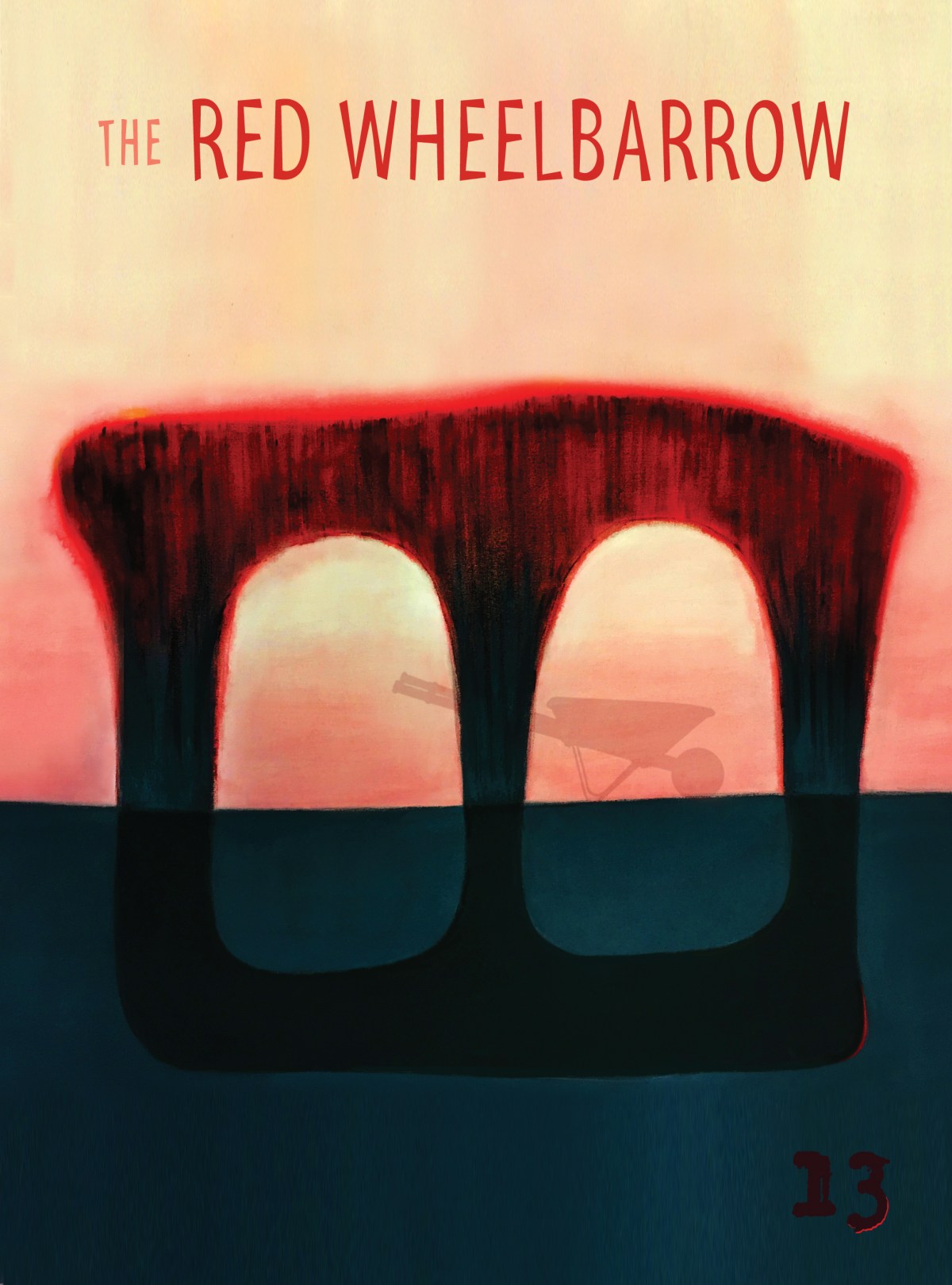
The Red Wheelbarrow # 13. Cover art by Paul Leibow.

A POET A WEEK! The year 2020 is going to be remembered for several things, not least of them how we found beauty, meaning and puzzlement and recorded them here, in our lucky 13th Red Wheelbarrow anthology!

Featured poet Zorida Mohammed joins more than 50 other poets pushing The Red Wheelbarrow in the direction of sanity. With 52 poets published here, our prescription for an antidote to a crazy year is to read a poet a week.Mohammed’s poetry looks back on her Caribbean upbringing and the forces that forged her adult life in America as a poet with an uncommonly keen memory and descriptive gift. In addition, we have published a short story that revisits her relationship with her grandfather in Trinidad.

And, after the feature on Mohammed, our lead poet is Rachel Wagner, whose brilliant “Men Follow Me to My Car in the Dark” will ring true to every woman and should be read by every man. Wagner is followed by R. Bremner, whose poem about the thoughts that flashed through his mind while enduring a stroke is instantly memorable. And that’s just the first three poets!

The 13th edition of our RWB is loaded with great poetry, essays and artwork, including the expressive line drawing doodles of Donald Zirilli and the hopeful cover art by Paul Leibow, “Women’s Future,” underlining the themes of the nearly two dozen women poets published here.

Get ready for some great literary adventures. You’ll find within these pages the vengeful nature of Osage oranges (Susanna Lee), the story of a hunchback right out of New York Gothic (Ken Vennette) and a mini-epic merging the stories of Hiawatha, the Last of the Mohicans, and a modern-day immigrant to New York City (Petraq Risto).

That poem, and the book, ends with Michelangelo’s finger of God pointing at the Statue of Liberty, a grand image to put up against a year filled with disasters. We also add a tribute or two to our retiring founding editor, Jim Klein, who it has been my privilege to succeed. The intelligence and energy of our one-a-week poets show that this anthology has a great future as well as an illustrious past.
—MARK FOGARTY, Editor

To order:
https://www.lulu.com/en/us/shop/mark-fogarty/the-red-wheelbarrow-13/paperback/product-4jqj8n.html

Type ORDER10 into the discount code box on checkout to get 10% off through September 18!

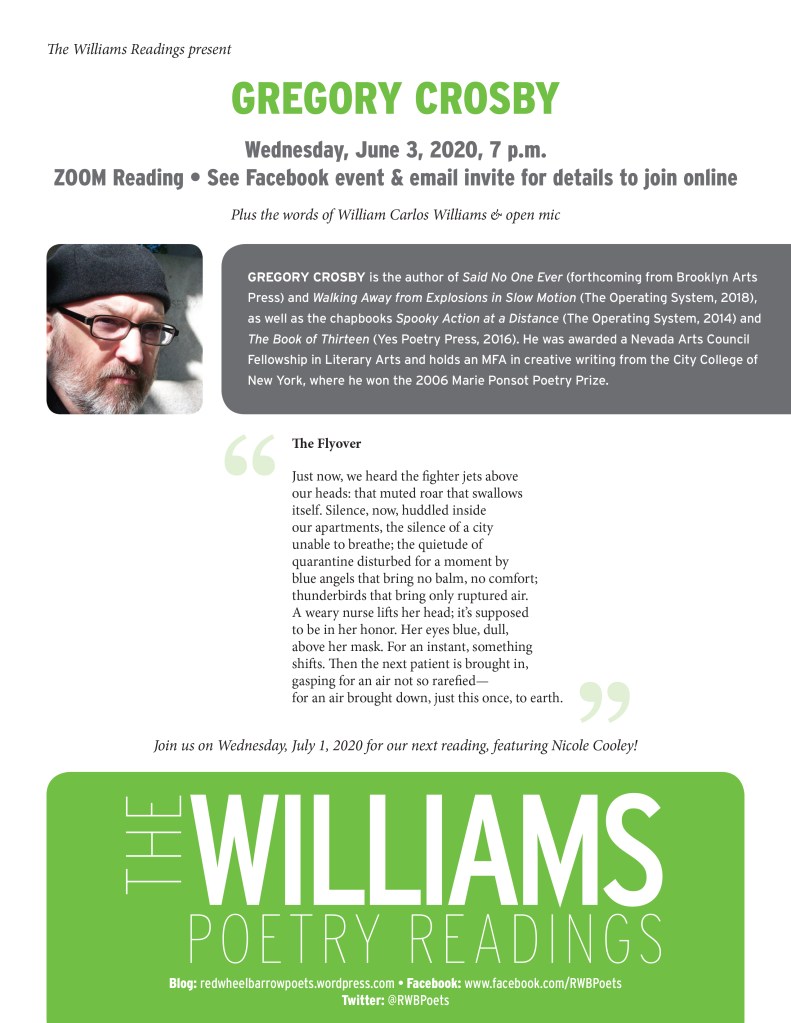
WCW on Zoom—Gregory Crosby—June 3

You are cordially invited to join us on Wednesday, June 3rd at 7:00 pm for our virtual Williams poetry reading on Zoom. Our featured poet will be Gregory Crosby, a noted Brooklyn poet.

Tune in to listen to his poignant poetry and participate in the open mic. NJ’s best and most vibrant reading series is alive and well on Zoom!

Instructions are given below on how to access our reading on Zoom. Much thanks to Frank Rubino for setting up our virtual reading and making it all possible.

We’ll see you all online on June 3rd at 7 pm. Until then, stay safe and be well.

Best Regards,
Claudia Serea
Frank Rubino
Arthur Russell
Anton Yakovlev
Don Zirilli

Zoom instructions:

If you’ve never tried Zoom, please download it from zoom dot com and get familiar with it. It’s pretty simple, and tons of people use it. If you have the zoom program but haven’t used it in a while, it’s not a bad idea to upgrade it to the latest version.

On Wednesday at 7 PM, when the reading starts, you’ll click the link below. You have to click one button for video and another for audio.

https://us02web.zoom.us/j/84557203032
Meeting ID: 845 5720 3032

When you get into the meeting, everyone will go on mute and the MC will kick off with introductions.

Use the Chat button to open the Chat panel.

For the open mike sign up, we’ll type our names in the Chat panel of the zoom meeting. I’ll remind you about it at the break. The MC will call off your name from the chat, and you’ll read your poem.

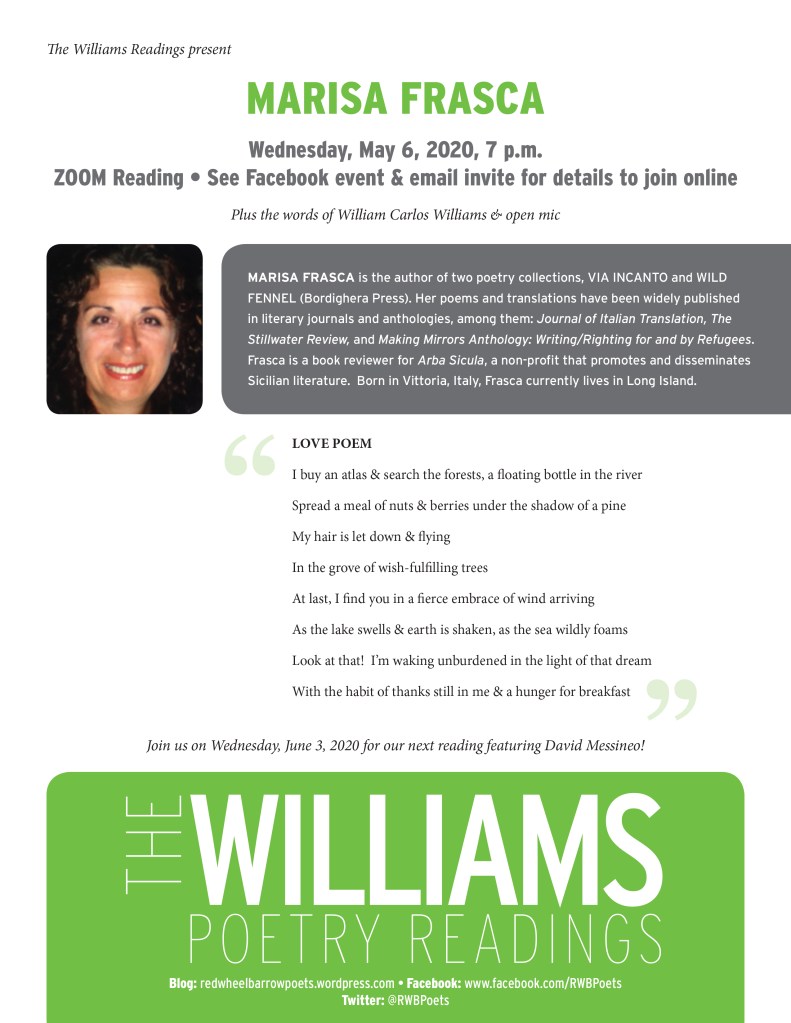
WCW on Zoom—Marisa Frasca—May 6

You are cordially invited to join us on Wednesday, May 6th at 7:00 pm for our first virtual Williams poetry reading on Zoom. Our featured poet will be Marisa Frasca, a very talented and accomplished poet.

Tune in on May 6th to hear Marisa read her passionate and poignant poetry. Participate in the open mic. NJ’s best and most vibrant reading series is alive and well on Zoom!

Instructions are given below on how to access our reading on Zoom.
We’ll see you all online on May 6th at 7 pm. Stay safe and be well.

Best regards,

John Barrale
Frank Rubino
Arthur Russell
Claudia Serea
Anton Yakovlev
Don Zirilli

Zoom instructions:

If you’ve never tried Zoom, please download it from zoom dot com and get familiar with it. It’s pretty simple, and tons of people use it. If you have the zoom program but haven’t used it in a while, it’s not a bad idea to upgrade it to the latest version.

On Wednesday at 7 PM, when the reading starts, you’ll click the link below. You have to click one button for video and another for audio.

https://us02web.zoom.us/j/86162776397
Meeting ID: 861 6277 6397

When you get into the meeting, everyone will go on mute and the MC will kick off with introductions.

Use the Chat button to open the Chat panel. For the open mike sign up, we’ll type our names in the Chat panel of the zoom meeting. I’ll remind you about it at the break. The MC will call off your name from the chat, and you’ll read your poem.

RWB Virtual Workshop—A Deeper Look

The RWB Poets started to hold online workshops on Zoom in an effort to carry on with our writing in time of pandemics. As a new initiative, we’re proposing that one of us will do a short process piece about a poem we workshopped on Tuesday.  Here is this week’s pick, Tom Benediktsson on “Ghosting.”

On “Ghosting”

“Dust.” Image by dre2uomaha0 from Pixabay.

I learned the term “ghosting” two months ago. Duh…not knowing it was a cliché, it seemed like a vivid metaphor. I thought back about times in my life when I ghosted or got ghosted, and then I remembered that dramatic day.

That’s how the poem started, breaking my rule not to write directly from personal experience. Usually I hide behind a speaker I’ve made up– a character, an alter ego. 

While writing the poem I also began to think about “ghosting” as a metaphor for writing. Writing, it occurred to me, can be a kind of “ghosting,” in the sense not of erasing but of inventing someone. Thus writing as that boy I once was is “ghosting.” A ghost writer, of course, is paid to write in someone else’s voice. Maybe all narrative poetry is ghost writing, except of course we don’t get paid. Maybe in all lyric poetry we invent a ghost of ourselves.  

But enough philosophizing. When I revise the poem I’ll drop the three ghosting definitions, for which all of the above was shorthand, and just tell the story, Tom! 

Hmmmm…. who am I when I tell “Tom” what to do?

Ghosting

I’m seventeen. Sitting in a hospital room,
failing to write a paper about Aristotle’s Ethics.
They wheel in my mother, post hysterectomy.
Her snoring stops when a patient shouts out
that the president has been shot.

My mother mumbles.
“Has the president been shot?”
I telephone my father the recluse.
“The president has been shot.”
“To hell with the president how’s your mother!”

I spend the day tending my mother
and checking on the news. That evening,
back at the university, my girlfriend of three weeks
wants to laugh hysterically, wants to dance,
wants me to be that cancelled homecoming date.

She doesn’t ask about the hospital.
I kiss her good night, realize I don’t really like her.
And so I don’t call her again. Ever.
Aristotle might not approve.

Ghosting: abruptly shutting down a relationship.
Ghosting: summoning the dead.
Ghosting: writing as another person.

It’s 57 years. That girl I hurt is a ghost.
That boy I was is another ghost.
My parents, ghosts. The murdered president.
And me