
Marc Pollifrone
the transorbital mustang
into fine lines of unfocused un-finite
hurling towards we are not
we are knodding on ether
how withers hastened
how lies too lest asleep
how much north matters
even yellow can pray
remember the brightly pink shaking
remember the some some of dreams is drenched
drenched in the squeaks of souls
in hallways of every waiting waiting
for the evisceration of weighting
it is always there
to hang you
in the fishing
of your leathers
drinkable on side tables
from the
fifties people call you
about gluten but not about toe nail clippers
remember milkshakes
mausoleums marooned on the
dastardly side table things
in time find stares at the belly of
mad mad
visage softly softly the crane sleeps
sleeps about midnight sugar coaxers
of incongruent powders from latrine sunsets
only light is pink
when you speak
of birthdays birthdays of all things birthdays
———————————————————————
Blog – http://redwheelbarrowpoets.org
Facebook – https://www.facebook.com/RWBPoets
Twitter – https://twitter.com/RWBPoets
WCW—Hilary Sideris & Rick Mullin—August 7

For the regal month of August, the Gang of Five is excited to co-feature Hilary Sideris and Rick Mullin, two poets of great talent and majestic expertise.
Please join us on Wednesday, August 7th, 2019, 7:00 PM, at the Williams Center, One Williams Plaza in Rutherford, NJ, to hear them.
About our features:
Hilary Sideris’ poetry has appeared in numerous print and online publications. She is the author of Most Likely to Die (Poets Wear Prada), The Inclination to Make Waves (Big Wonderful), Un Amore Veloce (Kelsay) and, most recently, The Silent B (Dos Madres 2019).
The poet George Held wrote of her latest collection: “Do not read The Silent B unless you love John Donne, Cole Porter, and Richard Pryor; unless you dote on word-play, satire, and wit; unless you cherish the silent “b” in “dumb,” cognates for “fire,” and the leap from “gaffe” to “laugh”; and unless you feel for the dyslexic, the dysphemic, and the different.”
Rick Mullin’s poetry has been published in various journals and anthologies. He is the author of seven volumes of poetry and two chapbooks, including Soutine (Dos Madres Press), a biographical novel in verse written in terza rima, and his most recent collection, Lullaby and Wheel (Kelsay Books, 2019).
The poet Anton Yakovlev wrote of Rick’s poetry: “From the moment you read the first poems in Lullaby and Wheel, you know you are in the hands of a master. Rick Mullin’s voice is one of the most distinctive and recognizable in metrical poetry today, and this collection sees the poet at the top of his form. Effortlessly switching from the whimsical to the philosophical to the deeply personal to the fanciful and again to the personal, these profoundly enriching poems guide the reader through a whirlwind of emotions and mindsets, recognizable and startling in equal measure.”
Please note: We must now pay $100 per month rent for the use the Williams Center for our readings. This is in addition to the $100 per month rent the Red Wheelbarrow workshop must pay for the use of their space in the Williams Center.
We need your help to survive and continue to hold our monthly readings. We will be asking for donations. A $5 per person donation is suggested. If we all contribute, we can pay the rent!
You can follow everything about the Red Wheelbarrow, its events and poets at these sites:
Blog – https://redwheelbarrowpoets.wordpress.com
Facebook – https://www.facebook.com/RWBPoets
Twitter – @RWBPoets.
RWB Workshop Poem of the Week—July 15
Arthur Russell
That Couple the News Had Followed
I saw us as that couple the news had followed
during the seven years it took the wife to descend
from adorable goofball to a head slumped in the wheelchair.
I thought of us when the cameras found him
on the sofa’s edge admitting he wasn’t up
to staying with her till the end. He was haggard.
He lowered his voice so she wouldn’t hear.
She was in the kitchen, at the Formica table,
sitting on a metal tube kitchen chair
with a vinyl seat cover and furniture tacks.
She had a terrycloth bathrobe on. The collar
was up, so she looked elegant gazing at the sink.
I love you just like that, that much, that broken way.
———————————————————————
Blog – http://redwheelbarrowpoets.org
Facebook – https://www.facebook.com/RWBPoets
Twitter – https://twitter.com/RWBPoets
RWB Workshop Poem of the Week—July 9
Zorida Mohammed
The Spirit of the Pines Still Haunts Me
I first set eyes on the two pines
in their adolescence.
They were so robust and so ferny and green.
They kept pushing upward
at such a rapid rate
I could almost see them grow.
The two pines became part of my woodwork,
always in the background of my daily life.
They billowed out, taking up a large space
on the ground and against the sky.
They seemed determined to poke a hole
in the sky.
They kept me company
when I made my 2 a.m. pee.
Avert my eyes upward, out the bathroom window,
and there they were,
always waiting, always welcoming.
Then came the gnawing drone of saws —
saws are always droning in the neighborhood.
The sound went on for two days.
First, the pines were defrocked of all the branches.
The two giants with their fresh wounds stood
as if in the town square, denuded and ashamed.
I could bear to look no more.
When my eyes did fall on that spot in the open sky,
phantom pines appeared and melted in my eyes.
———————————————————————
Blog – http://redwheelbarrowpoets.org
Facebook – https://www.facebook.com/RWBPoets
Twitter – https://twitter.com/RWBPoets
RWB Workshop Poem of the Week—July 2
MARK FOGARTY
IMPOSSIBLE TO WHISPER HER RACING MIND DOWN
Whenever you talk about stable housing,
I think of horses, she says.
When my mother was my age,
She used to break horses on the res,
What a badass! I could do it, too, bareback.
You make friends with the horse first,
She’s cantering around, spooked,
You whisper in her ear how beautiful she is,
She with her straight hair and you with your angled,
You lean your hair against hers, and she knows.
You ask her permission to swing up on top,
Feel the rocket strength of her between your legs
Where I am strong, too, where I carry my people’s beauty.
Then you grab her by the mane
And ride, fast, through the long, green grass of the res.
And then you slow, slow until it’s logical to get down again.
Except for the horseshit, she says, I don’t think I would mind stable housing.
———————————————————————
Blog – http://redwheelbarrowpoets.org
Facebook – https://www.facebook.com/RWBPoets
Twitter – https://twitter.com/RWBPoets
RWB Workshop Poem of the Week—June 24
Susanna Lee
Trusting Detritus
My favorite log of all time had pale green lichen over almost all of it
but was basically solid and dry.
I could find it every time I scavenged for firewood behind our campsite at Stokes.
It pointed the way back.
It had fallen on level ground.
I could trust it not to fall apart or teeter when I walked the length of its spine.
It would always be a pirate’s gangplank for me when I needed one.
Bits of lichen would break off under my sneakers, but always grew back.
My kids laughed at the ridiculous notion a person could get lost in the woods,
or would come to love the peculiar way detritus gathers meaning over time.
Trusting detritus seemed like crazy talk, I guess,
easy advice to discard.
———————————————————————
Blog – http://redwheelbarrowpoets.org
Facebook – https://www.facebook.com/RWBPoets
Twitter – https://twitter.com/RWBPoets
WCW—Jim Klein—July 3
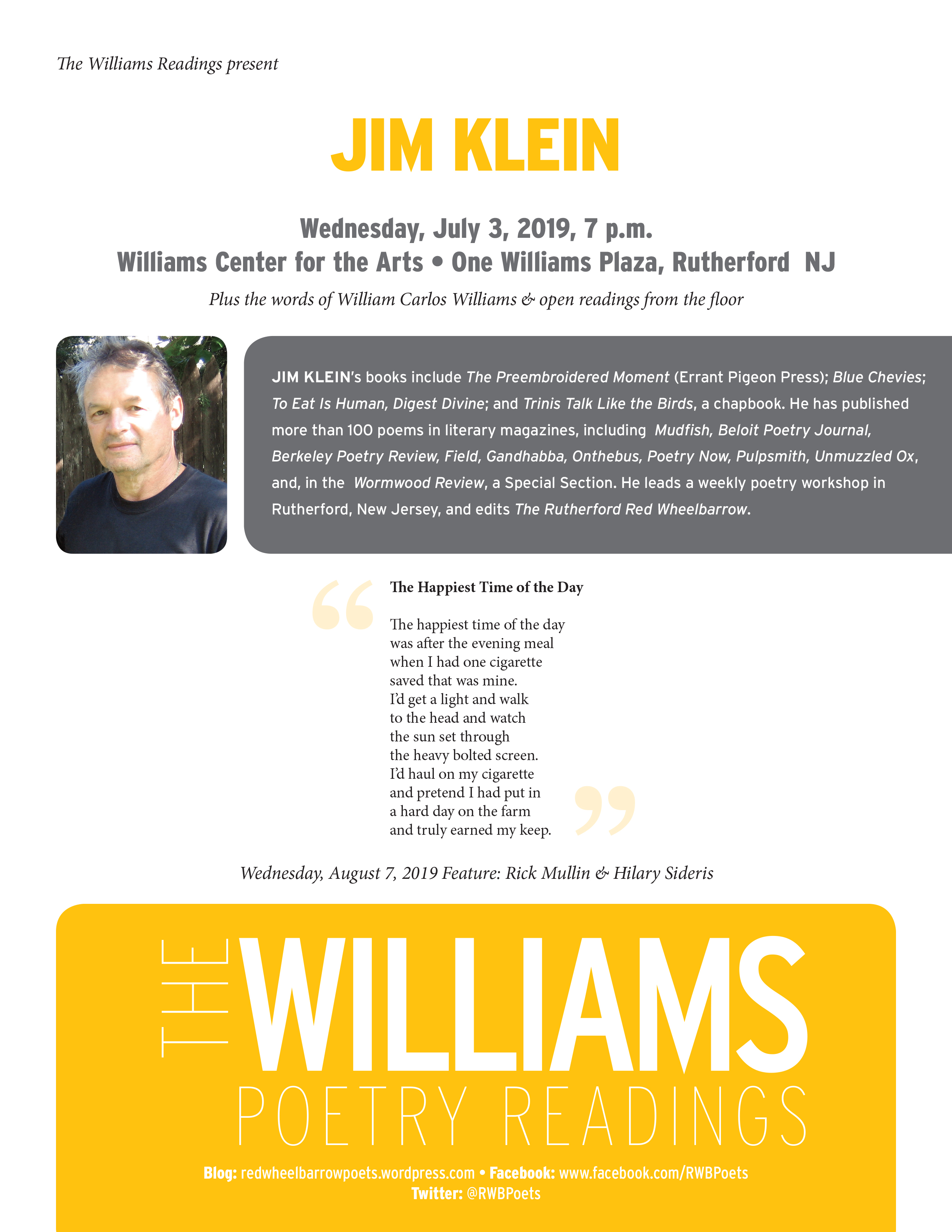
It is a special honor this July for the Gang of Five to present Jim Klein. The Godfather of the Red Wheelbarrow offers you some poetry you can’t refuse as he showcases his new book, The Preembroidered Moment.
Please join us on Wednesday July 3rd, 2019, 7:00 PM at the William Carlos Williams Center, One Williams Plaza in Rutherford, NJ, to hear Jim read.
About our feature:
Jim Klein is editor-in-chief of The Red Wheelbarrow and the moderator of The Red Wheelbarrow Workshop—Rutherford’s iconic poetry workshop that has met weekly since 2005. Jim’s poetry has been published in Beloit Poetry Journal, Berkley Poetry Review, College English, The Wormwood Review, and in numerous other publications. In 2007, Jim’s manuscript I Didn’t Know If I Was Afoot or on Horseback was a finalist in the Anthony Hecht Award Competition and in the Sawtooth Poetry Prize. Jim is the author of Blue Chevies (White Chicken Press, 2008), To Eat Is Human Digest Divine (White Chicken Press, 2010), and the chapbook, Trinis Talk Like the Birds (Errant Pigeon Press, 2011).
Please note: We must now pay $100 per month rent for the use the Williams Center for our readings. This is in addition to the $100 per month rent the Red Wheelbarrow workshop must pay for the use of their space in the Williams Center.
We need your help to survive and continue to hold our monthly readings. We will be asking for donations. A $5 per person donation is suggested. If we all contribute, we can pay the rent!
You can follow everything about the Red Wheelbarrow, its events and poets at these sites:
Blog: https://redwheelbarrowpoets.wordpress.com
Facebook: https://www.facebook.com/RWBPoets
Twitter: @RWBPoets.
Gainville Reading Series Starts 11th Year with Mary Ma and Acoustic Joe!

The Magic Circle series returns to GainVille Café Friday, June 28 as we begin our 11th year (!) of poetry and music in Rutherford. Our poetry feature will be MARY MA, author of the chapbook Windows, Mirrors. Mary is a disabled, queer, non-binary writer and educator and a member of the Red Wheelbarrow Poet’s’ poetry workshop.
Our musical guest will be guitarist ACOUSTIC APOTHECARY JOE DELGIODICE, who has played in our open many times and in the Tribe of Uncles.
Also featuring the Red Wheelbarrow Poets’ Bring-Your-A-Game open mic.
A $9 cover includes coffee/tea, dessert.
7 PM, GainVille Café
17 Ames Avenue
Rutherford
201-507-1800
RWB Workshop Poem of the Week—June 11
Arthur Russell
More On Cash
If you take a nickel from every person you meet,
you will soon be rich, and if you give a nickel to every person you meet,
and if you give a nickel to every person you meet,
you will soon be poor.
—A rich guy
We were a mercantile people, not honest per se,
not even significantly honest,
but not completely lacking in honesty.
We were honest as plunderers,
fair as pirates, transparent as three-card monte dealers.
We stole from our employees. We stole from our customers.
We stole from the city, state and federal tax man,
from the water company, the electric utility,
the telephone company, from our vendors,
from our banks, from passersby, from the future, and from the past.
We saw ourselves as street-smart operators.
We saw ourselves as even-handed merchants, buyers and sellers,
but there was no one from whom we did not take.
We took stuff from people’s garbage.
We took stuff from their cars.
We saw the dishonesty of the world
and we wanted to be successful in it.
We did not strive to better ourselves
or to better our neighbors.
We only wanted the world to go on
as it always had, with all of its beauty
and injustice and to leave us to our business.
We didn’t see what we did as evil.
We simply saw it as business, business, business,
and the rule of our business was simple and monolithic:
Everything is ok, as long as at the end
of the day, we go home with all of the money.
All of the indignities we suffered—
the dirt, the cold, the working when sick,
the men who cursed you, the customers
who rode you, the arrogant cops
and the filth in the pit, the patience
that was required and required and required—
were tolerable as long as we got the money.
The “everything” that was OK as long
as we went home with all of the money
included the injustices of the world,
the callous way we became with it,
the upside down and inside out,
the hopeless, the useless, and the bleak.
All of that, according to us, according to our creed, was OK,
as long as we got the money, as long as we went home with it,
and when we got home with it, we would lay it out on the table,
folded, marked with pencil in the open spaces,
wrapped in rubber bands, packages
of $450, $900, $800, $600,
packages we made when we cleaned out the cashier,
tucked inside our tucked-in shirts
and carried to the office, and put in the safe
and at the end of the day, after closing,
in the same way — tucked inside our shirts
or in supermarket bags folded to look like a newspaper
you might carry under your arm.
Cash and cash and more cash,
night after night, that we would take out
and examine at home, behind the curtained windows,
in the formal dining room with Early American furniture,
with blue on white tree-design wallpaper
that was copied onto the curtain fabric;
we would empty out our shirts and inside pockets
onto the dining room table, our fingers still dirty,
our fingernails still dirty, our pants and faces set from work,
and look at and count and flip the bills
so they all faced up (my dad) or down (my brother)
and count them down (my dad) or up (my brother)
and pick a clean bill for the top of the pile
and write on it with a pencil (my dad)
or a pen (my brother) in the blank space how much,
and then stack it and separate it,
and stack it and pile it and pass some out
and put the rest into hiding places in the ceilings and the floors and the walls
and the floors and the walls
and the pockets of coats in the attic
and in the cookie tin
that was under several inches of dirt
in the crawlspace under the front porch,
or actually, sometimes, we put it
in the safe in the closet in the master bedroom,
though not that often, because the safe
was more or less reserved for my mother’s jewelry
and my father’s gold coins and little packages of diamonds,
one each, folded into doubled paper,
folded the same way cocaine used to come folded,
each folded package with writing on the outside,
saying the exact weight in hundredths of carats
and the color and the clarity with letters like VS and VSS.
And, until they were outlawed, there were bearer bonds
you’d keep in a safe deposit box where you also kept a pair of scissors,
go upstairs and cash in coupons with the teller.
Money was the family business.
This fixation on making and keeping money,
in small amounts of cash, cash, cash,
had been our family heritage for a hundred years.
We were people who got into a thing and stayed with it for a long time.
We didn’t borrow money except from ourselves
and bought things from which we could make more money,
whether it be adding machines or real estate.
We ridiculed people who spent money on leisure and luxury:
watches, cars, vacation homes or trips abroad.
We didn’t ridicule the fine things themselves,
but we ridiculed the people who strove
to have lobster
because lobster
was vanity.
We bought our cars standing on a street corner
or in some guy’s dirty little office just like ours
with the cash in our pockets.
We sent our kids to college with tuition money
from the cash register. We took mortgages to buy houses,
but only to avoid the suspicion of the IRS,
then we paid the mortgages off as soon as caution allowed.
———————————————————————
Blog – http://redwheelbarrowpoets.org
Facebook – https://www.facebook.com/RWBPoets
Twitter – https://twitter.com/RWBPoets
RWB Workshop Poem of the Week—June 4
Della Rowland
The Undertaker
If you were 22, newly married, uniformed, and ready
to ship out with your unit but found yourself
under a clean white sheet coughing up TB blood,
then rehabbing with your bride at your bedside
in a slim skirt and fuck-me pumps,
her photo in the wallet you meant to take with you to the front,
the one of her with her dark wavy hair swooped up off her forehead,
wrapped in a snood at the nape, a gardenia behind her ear like Billie,
you might feel the living’s guilt when three quarters
of that bonded unit was killed right off the boat ramp.
You might think you were always lucky
and you’d have been the heads side of that coin flip
to see who goes and dies, or stays and lives.
You might believe, having tricked death once with TB,
that you could stay in that good grace
by selling life after death in your three funeral homes,
where a body is brought to look natural again,
where the family would pay someone to take its bones back to earth.
You might hope that the grieving living would never forget you,
your vividly empathetic eyes, your sudden chivalrous gestures
as if to save a swaying vase from shattering on the floor,
like when you bolted from a chair to grab a tissue
and dab a mourner’s eye with the familiarity of kin.
You might wish to hear everyone who crowded your wake
and gravesite proclaim their love
and recount their particular memory of your kindnesses,
as if they knew how carefully you placed their dead
on the porcelain table with a drain at one end,
how you patted their hands after massaging the blood out,
preserved their modesty with a white sheet.
As if they knew you saw each car-wrecked body that came to you
as a boy from off the battlefield,
uniform in tatters,
whose smashed-up face and bloodied hands
must be restored.
———————————————————————
Blog – http://redwheelbarrowpoets.org
Facebook – https://www.facebook.com/RWBPoets
Twitter – https://twitter.com/RWBPoets
 The Red Wheelbarrow Poets
You must be logged in to post a comment.