It includes a well-known 1991 essay, Some Aesthetic High Points, which, Kelley says elsewhere, had been taken as an earnest anti-aesthetic manifesto— but is really one of his jokes: a takedown of pompous artist bios. It includes his memories of winning a poster contest in grammar school, and seeing an Iggy Pop performance in a biker bar. Another takedown of what I would call a structuralist seriousness, masquerades as an essay on a collection of “sacred” American photographs Kelley childishly defaced (swastika drawn on Lincon’s forehead, etc.) (Reconstructed History, 1990)
In The Poetry of Form, Kelley writes about found naming systems: Geological formations like “The Frozen Cascade” and paint chip colors found in hardware stores. The color of my bedroom is “Soft Chinchilla” He says that he wanted to “stress the naming process… as the primary aesthetic characteristic” of the color or rock formation. He was also intent on the anonymity of the naming process, and He created many artifacts (photos, drawings) based on his research into these naming systems. I thought of the poem “Bad Rock Band Names” by Wayne Miller, which he read at this month’s open mike. (Forgive me if I screwed up the title, Wayne)
(One of my favorite naming systems is cannabis strains: Ghost of Leroy, Jilly Bean, Alaskan Thunder F**k…)
Another association of Kelley’s work to a workshopper is the section in Minor Histories called UFOlogy: Kelley lists, among other things, the many detailed UFO descriptions he came across in his research on the subject. It reminded me of Janet Kolstein’s poem, where the speaker describes a ufo.
So, we have in just this sample of Kelley’s work a list of artistic pretenses you can use to structure (or at least jump-start) a poem:
1. Fake bio (I use this one constantly)
2. Pompous exegesis (actually I’m thinking of Susanna Lee’s recent “Viking Love” poem as an example of this)
3. Found lexicons and taxonomies
4. Deep research into trivia
(Also I can think of Don Zirilli’s heartbreaking instruction manuals as well)(And John J Trause’s “future hagiography” of Marilyn Monroe)
Arthur Russell‘s recap of The Red Wheelbarrow Poets’ Workshop of March 15, 2021
We had a good time at the old Zoom last Tuesday, with poems of metamorphosis, dreams, nostalgia, you know, the stuff we .
Claudia Serea’s “At 3 a.m., I held my parents” is a dreamlike free verse poem in nine couplets in which the parents are depicted as metamorphic presences that the speaker holds, loves and loses. When the poem begins, the parents are held like children on the speaker’s lap, then compared to weightless birds who wriggle free, “spread their wings and swoosh[ ] off.”
Don Zirilli’s poem, “How to Remember a Dream” enters the same landscape of dreams that Claudia’s poem occupied, but rather than presenting the content of the dream, it is presented as a ‘how to’ poem, that focuses on the process rather than the content of the dream. Like many poems in the ‘how to’ genre, there’s a bit of tension between the title’s promise of an easy-to-follow set of instructions, and the more difficult emotional content that follows. Three imperatives — “walk” “feel” and “report” – carry the ‘how to’ device forward, but particularly in the ‘feel’ section, the instructions illuminate rather than resolve the difficulties of remembrance, as they show us the imagined student receiving the content of the dream like a “frosty night of weather” transdermally through a their forehead resting on the cool glass of a window:
Feel the cool glass against your forehead
until you’re transparent, no longer
in the way
of the story you’re telling
to the person who is actually having the dream
and slowly pours a frosty night of weather
into you.
Janet Kolstein’s free verse poem, “Black Cat on a Cobblestone Street” was a lovely ekphrasis of a 1927 silent film directed by Walther Ruttman, called “Berlin, Symphony of a Great City.” While Ruttman’s film is famous for being the first or one of the first “city films” (here’s an article about it: https://www.popmatters.com/berlin-walter-ruttmann-2620911194.htmlabout) which can be seen as a celebration of modernity and urbanity, or a partly Marxist social critique on the on the dehumanization brought about by industrialization, Janet’s poem is more of an ‘ubi sunt’ poem, a contemplation of mortality and the transience of life, in which she considers how the people depicted in the movie are now dead and gone.
Speaking of old movies, Shane Wagner brought a poem called “A Pretty Good Team,” you might call a free verse poem, but not really, since it was written, in part, under the constraint of following the versification of the song “Let’s Call the Whole Thing Off” by George (music) and Ira (lyrics) Gershwin (1937), for the movie “Shall We Dance” where it was sung by Fred Astaire and Ginger Rogers while dancing in roller skates. Shane takes this lyric about incompatibility (toe-MAY-toe/ toe-MAH-toe) and makes it about domestic compatibility.
My poem, “I Imagine the Earth Absconded” is set up rhetorically as Petrarchan sonnet (octave and sestet) in unrhymed lines that hearken (loosely) back to iambic pentameter. The subject of the poem is the traditional one of leaving home, coming back and remembering the journey. The poem hinges on the two sides of a simile (tenor and vehicle) which are deliberately conflated: (1) the fanciful device of the Earth leaving the solar system to visit a faraway galaxy, and (2) the teenager who leaves home to go to California, meets a girl in a health-food-store and returns home with artifacts (serape blanket, old car) and a souvenir of his time away (a pillowcase). The intergalactic imagery of a planet leaving its orbit provides some emotional substance to the difficulties of leaving one’s assigned orbit, and the powerful pull of gravity that brings one back to their “endless falling groove” and the pillowcase souvenir with its embroidered “border of yellow stars” embodies the way those journeys live on in a domesticated life.
Barbara Hall brought a pair of haiku “Haiku for my parents.” Both halves of the poem, mom and dad, dealt with death, the dad piece with a startlingly self-aware moment of gentle punning self-mockery by the dying father who says his hands are “the ends of me” and the mom piece with a detail of the funeral – lipstick color – that illuminates the intimacy of a daughter’s knowledge. Don Z commented that it was interesting that the haiku for the father follows the haiku rules, but the one for the mother did not. There was some discussion as to what the poem gained from presenting itself as haiku.
Susanna Lee’s poem, “Ruckus” is a poem, like Barbara’s about parental mortality, in which the speaker’s father, suffering from Alzheimer’s disease, is furious about losing the ability to read, and tears a paperback apart. The description of the “tortured” book being torn apart becomes a metaphor for the father’s losses engendered by the disease.
Raymond Turco brought a poem called “The Chef” written in the second person to a “you” who is the cousin of the speaker. The poem has the candor to recognize the cousin as “”harsh/ like bitter dandelion greens” the respect to admit that the speaker is humbled when she chides him, and ends by celebrating the comfort that the speaker feels when he sees her act of kindness in making his bed. The poem is written in short free verse lines that are set up in three long stanzas; we didn’t have time to discuss the way this form relates to the content, but it would be a good thing to look at.
Frank Rubino’s poem is called “Gasoline is a living chemical.” The poem is in three free verse sections separated by bullet dots. It starts in the Covid present with the “we” of the poem, possibly husband and wife, getting vaccinated at an old Sears store they had visited (together or separately?) as children, and “played… in its overcoat racks…” Within that moment, the speaker reminisces about the connection between that old Sears store and the people who frequented it being possible workers at a clothing factory who might have been customers of his father’s lunch truck, including perhaps the foreman at the factory who had “put aside some dresses for my sister.” The poem returns from those reminiscences to the vaccination moment where the ‘we’ waits for possible adverse reactions to the shots while listening to muzak on the old Sears music system, and then returns to the domestic scene at home, talking to kids. The second and third sections of the poem ruminate on the moment: the vaccination event held side by side with the situation in Novogorod Russia when the couple adopted their baby, and in a larger sense, the idea of being in a strange public space.
Jen Poteet’s poem “With Authority” is full of humorous observations about idiosyncrasy and trivia, such as how different sorts of columns (Ionic and Doric) can lead to remembering a (very very old) tv car commercial featuring the actor Ricardo Montalban talking about the rich Corinthian leather in a Chrysler Cordoba.
I’m fond of this piece, and I like many other Mike Kelley works too. Sadly, he committed suicide in January of 2012. I read on Wikipedia (https://en.wikipedia.org/wiki/Mike_Kelley_(artist)) that mourners spontaneously recreated “More Love Hours” as a memorial.
More Love Hours, with its stitched-together stuffed animals, uses overtly “sentimental” materials. It’s transgressive (or was, or still is, or is even more?) in that it “ high arts” yarn and sewing and platitudes. As a blanket-sized wall hanging, it references quilting & seems humble and sincere. Its title which contains the phrase “Love Hours” (the time people spent creating giveaway toys) has a clumsy earnestness. It functions as a “message” whose literal meaning is easily parsed.
I don’t know why it works for me: I was taught that sentiment is the enemy of true feeling. Sentiment “manipulates” and numbs, and is often used for political ends yet I react with feeling from More Love Hours Than Can Ever Be Repaid: I empathize with the artist’s tenderness and the restorative labor in his collecting, composition, and construction of More Love Hours, a reflection of each person that produced each hand-made figure; I hear in the title, More Love Hours Than Can Ever Be Repaid, Kelley’s own acknowledgement that “curating” and “assembling” this famous piece, while labor-intensive, took a fraction of the cumulative effort in the construction of every crocheted, sewn, knitted, glued, cut-out, sequined etc figure in the amalgam.
More Love Hours is hanging in a carefully controlled mainstream culture industry environment, a very expensive piece of real estate, and engagement with it is highly proscribed. I can’t take it off the wall and roll around the floor with it. I can’t even really get close enough to smell it.
And yet, I still love it and want to cry thinking about it. I don’t know whether its remoteness (amplified by Kelley’s death) conjures such closeness?
Carl Phillips talks about the balance of pain and decorum in great poems.
Can one use sentimentality as the decorous side of that equation?
Do you write sentimental poems?
We have seen many successful workshop poems with sentimentality in the balance… and many unsuccessful ones (including mine!) As the Coffee Talk ladies had it, Discuss: “poetic” guardrails against counterfeit feeling don’t work anymore. Sentiment is no longer sentimental. Sentiment is useful in fact in creating the ironic distance required by decorum. I love some poems like I love More Love Hours- how do those poems work, those tear jerkers?
Frank Rubino’s letter of invitation and inspiration to the weekly Red Wheelbarrow Poets’ Workshop of March 9, 2021
Hi Everybody-
Last week, I wrote:
Billie Eilish divulges high-stakes intimate secrets directly to people who keep the same secrets.
Poetry can make this same deeply intimate connection when readers feel known.
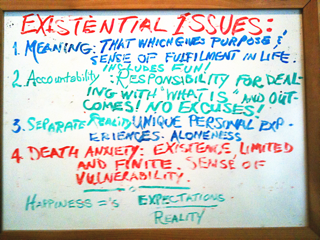
This week, I want to return to the idea of making the reader feel recognized. For me, poetry’s ability to connect deeply addresses a principle of Existentialism the therapist Roger Wolfe displayed on a whiteboard in his office:
I’m talking about item 3. “Separate Reality: unique personal experiences. Aloneness”
As a kid growing up Catholic, I was taught that God could hear my thoughts: that’s a terribly damaging idea for so many reasons, and it’s a relief to now believe it is completely false. But while it held sway, that belief in the divine ear helped me form an articulation of my inner life that tells a good story, makes my case, frames the unexplainable. I am sure that I share this with others who had a Catholic childhood.
I can’t blame “wanting to be known” on Catholicism, though: it seems crucial, pre-verbal. I did want some people, if not God, to hear my thoughts, and that the people never can is a source of sadness. We live in separate realities like the whiteboard says. The thoughts are translated to language, the language is edited, etc.
When someone (often an artist) expresses what I hear in my head, I love them: I must be known. Like a true fan loves Billie Eilish for knowing them.
Poetry is the voice in your head when you’re reading it.
Poetry is the voice in the poet’s head when they’re speaking it.
Billie Eilish is the voice in her fan’s heads.
I think, in trying to talk about a very basic thing that poems do, I just confessed my infantile need to write them. Oh well, Now you know.
Frank Rubino’s letter of invitation and inspiration to the weekly Red Wheelbarrow Poets’ Workshop of March 2, 2021
Hi Everybody-
This week I watched The World’s A Little Blurry, https://apple.co/theworldsalittleblurry about Billie Eilish. My kids introduced me to Eilish’s music and theatrical aesthetic, which was nightmarish and dealt familiarly with issues of mental illness like cutting and suicide. That they should esteem it or vibe with it freaked me out as a parent. I think they knew that when they gleefully showed me her megalomaniacal You Should See Me in a Crown https://youtu.be/coLerbRvgsQ . But the anime music video (by Takahashi Murukami (their collaboration is documented in an interview https://youtu.be/TVTzOOBxCog )) made me a Billie Eilish fan. I loved the combination of 2D flatness and dark epic scope, the appropriation of Studio Ghibli for psychotic purposes (a pair of terrified flowers, their faces uplifted to crushing doom, is as powerful and effective an image as you’re likely to find in poetry) as well as Billie’s self-caricature. The restraint of her vocals, their murmuring and lullaby sounded original and worked to unify the song with the visual’s monstrous imagery. Her vocal’s whispery seductiveness is countered by the live Billie’s signature loose-fitting clothes and child-like stage-scampering.
I said I was a fan, but I will never be a real Billie Eilish fan. Real Billie Eilish fans identify with her so deeply it’s as if their inner lives are interchangeable. There’s self-recognition. I think I came close to being a real fan when my children were in their teens, and I had their inner lives much closer to me, and therefore I had Billie Eilish’s inner life closer to me. But now, though I can feel it like distant sunlight (and though I can access numerous other human feelings in her music), I can’t live the Recognition connection:
Billie Eilish divulges high-stakes intimate secrets directly to people who keep the same secrets.
Poetry can make this same deeply intimate connection when readers feel known.
The aspect of Billie Eilish I did not talk about is Fineas, her brother & collaborator, who provides the entertaining, sonically inventive, delightful musical solution that flows the Recognitions along. So there’s an element in her emotional bond, as in poetry’s, of technique and art.
How do you connect deeply with your reader? Since we’ve often talked about entertainment as a way to connect to the reader, I am in mind of what Geoffrey Hill said. “Poetry is a strange angel and has very little to do with enjoyment actually…. “Enjoyment” is patronizing and possessive… when you “enjoy” a poem you say, “You are mine, and you please me in my current mood.” And the angel of poetry says, “Sod off. Sod off!””
Arthur Russell‘s recap of The Red Wheelbarrow Poets’ Workshop of March 2, 2021
Hey everyone.
Tom Benediktsson’s poem, Allegory, told an allegorical tale in two free verse stanzas of 8 lines each more or less iambic, more or less 4 beats per line. The tale he tells is of a couple, known only as A and B evidently at a bistro “sharing a small table.” A’s gluttony is the subject of stanza 1. B’s finickiness (to put it mildly) is the subject of stanza 2, which ends with her leaving the bistro, “walking at a calorie-burning speed…” Maybe this poem is an allegory because A and B are universal characters, but I think, too, you can see the allegorical scrim as a distancing device or shock attenuator for the disturbing scene of B “grimacing with revulsion,” after “toying with a single bean/ on the black and white checkered tablecloth.”
Janet K brought a poem called “Tall Ships” (not attached) that addressed “unrequited romance/ experienced as a kind of exile forever from love itself” and the strategy of acquisition that offsets the unhappiness: tchotchkes. “They turn to objects,” she writes, which are, themselves “meditations on the human touch,” whose effect is “mysterious, like the tall ships.. coming down a fog-shrouded river,” called “a succor for the heartsick” that keeps them, chilling, “far from that trip to the chemist,/ the rope.” And then, in the conclusion, she imagines the heartsick consoling themselves saying “I own you,/ you’re mine,/ you’re my moon-faced mantel clock,/ my kimono embroidered with a field of jonquils.” And as I think it was JJT, who pointed out, that jonquils was such a powerful last word for the poem, known but unusual. My only quibble with this poem was the verb “spy.” Great work, Janet.
Lan Chi Pham brought a delicious poets-only poem about falling in love with poetry and then trying one’s hand at it, called “Poem a Day”, which envisions the speaker having poetry prescribed as a treatment for the blues. “Better do what the good which doctor says,” the speaker says, then the next two stanzas describe in an evolving poems=food metaphor, how she accelerated from “free verse” for lunch to “the heaver stuff” which she “devour[ed] like a bottomless/ Hurricane of word-hunger.” Finally, she tries her hand at “homemade poem” which is “Yum yum” though the poem ends humbly saying her poem was not as good as “The store-bought stuff.” Zirilli, who wasn’t there last night would say, it’s a poem that sticks to a single metaphor all the way through, and that’s a comfort but more than a comfort, a pleasure to the reader.
Yana Kane brought a poem called “Trees dreaming in winter.” Well, now you know pretty much all you need to. Just kidding. Yana’s trees dream, but their dream is the poet’s imagination of the world in winter embodied in trees that “drink in the stillness that pools/ beneath all layers of the ground,” and whose “crowns bloom with constellations” (someone said this is like looking up through the bare branches on a starry night). In the poem’s last movement, Yana has the trees veer further into fantasy with “winged beings” and “luminous fruit” that “flows far beyond the shores of the known world.” It seems as though Yana reaches for the mystical as confirmation that her poems have done that too.
Shane Wagner brought a rewrite of the piece from last week in which he, Robert Frost and Jen Poteet took a walk in the woods; now it’s called “Turn Home.” (By the way, ignore the last paragraph on the page. Shane says it’s not part of the poem.) This version is prose too, prose poem maybe, and it starts essayisticly noting that the country and world have had a lot of anxiety lately, and he’s feeling relaxed, noting that a cactus rescued from the neighbor’s trash last summer is “feeling comfortable enough to produce lewd fuchsia blossoms” and the “icicles seem more willing to hang.” Cute joke. But then the piece turns to the speaker’s special needs child care duties, and from that to a scene at a “special needs picnic” where another father did what was needed for his special needs child, before landing heavily in the double edged worry about who, in a special needs family, will die first, father or child. Nice prose piece.
Way at the other end of the “is-this-poetry-at-a-poetry-workshop” spectrum, John J. Trause (who will be the featured reader at tonight’s Williams Center Poetry Reading (on Zoom): be there) brought a graphical poem called “Untitled” which consists of the word ‘untitled’ written in big letters down the middle of the page, the word broken up, two letters per line, and presented in a stencil typeface. This is concrete poetry, defined as an arrangement of linguistic elements in which the typographical effect is more important in conveying meaning than verbal significance. For more on that topic, you may want to look at Charles Olson’s essay “Projective Verse” and/or Brian McAllister’s critical piece “Narrative in Concrete / Concrete in Narrative.”
Frank Rubino’s poem had a really long title! “Shift toward helping, shift toward light, and, soon, in four or five breaths, sleep.” Someone called this an internal monologue, which led to a fistfight (just kidding). Whether it’s really internal, or a piece spoken to this audience, it’s a ruminative piece, like many of Frank’s poems, in which he toggles between declarative truth reach (“My words are my mind”) and close attention to his body (“the way my wrist moves”) questions (“Isn’t that such wasted time?), natural observations (“The robin sat in the dogwood trying to see through the window./ I don’t think birds can./ His body is fluffed for the cold.”) and genuinely lyrical moments of love (“My hauntedness is the same hauntedness as yours./ Our hauntedness is the forward movement of time./ I wish there was a time syrup that would end time forever.” So beautiful). And Frank is dedicated to not privileging one vector of his speech over the others, which makes it tough for lovers of his sweet lyricism, but hey.
Raymond Turco, fresh from the completion of his Italian Heroes manuscript brought a song lyric called “New York is” that tried to capture the spirit of NY in some of its well worn cliches: it has 8 million people none of whom would stop if they saw a corpse on the sidewalk, it is dirty and smelly and, its people all “chase Fortune.” As Brendan pointed out, that may well depict Manhattan, but there are four more boroughs and nuance out there.
Barbara Hall brought a poem called “The Birth of Virtual Reality,” about the death that came with covid, which she represents in the death of an uprooted apple tree, compares to the ivy on Snow Whit’s castle, and finally in a “story” he tells that is both made up and “too real.” And then the story:
she died last fall.
I picked up the shovel unceremoniously,
dropped dirt on her pinewood casket,
Never to see her again.
Virtual Reality took her place:
No face, no mouth, no eyes, no smile.
That’s one hell of a story.
Brenden McEntee brought a five-stanza poem in unrhymed tercets called “Before Bedtime” that Tom B described as having a three stanzas that start “before bedtime” and two stanzas that start in dream (a dream city and a dream desert) all of which share a dank and brutish view of life. If he overstates (or if I misquote him), there’s no doubt it summons up a life in which the family is the insular protected center of a dangerous world, and even in that protected center “You go to disaffected prayer and childhood/living; I double check the locks and night-eclipsing clouds.” And the poem ends chillingly in its last tercet, which still somehow the family at the center:
Every night, before bedtime, you tell me: “come the new day,
We will bless what needs to be blessed and we will kill
Who needs to be killed and therefore, ourselves, stay safe.
My own poem was a re-write and supplement of my unnamed last week poem about mothwing newspapers. Now it’s called “Mothwing Trilogy” and each of the poems in the trilogy (all circling around sonnet length) has its own name: (1) My Grandfather Read a Newspaper for Moths Which, Oddly, Was Printed on Mothwings” (2) “Which Fey Light?”; and (3) “Butcher Paper Tally On the Use Of “Oddly” In the Title of My Mothwing Poem.” In some sense, poems two and three are midrashim on poem one, but in another sense they are a triptych in whose center panel a scene of comforting domestic scene unfolds, and in whose outer panel, pandemonium. I think I’ll leave it there.





 The Red Wheelbarrow Poets
You must be logged in to post a comment.