RWB Workshop Poem of the Week – Feb 11, 2015

Zorida Mohammed

THE SKIN I LIVE IN

This skin I live in,
that I was born wearing,
can teach elastic a thing or two
about resiliency and stretch.

It has gone from covering a mere 6-7 lb. babe
to a chubby blubby 150 lb. teenager,
then settling into a svelte 115 lbs.,
premarital, lyric of a girl-woman.

This forgiving skin stayed in idle at 125 lbs.
until madam menopause levied her hand
in my late forties, pushing me off the scale
into territory approaching 130 lbs.

At 60, things are still nicely intact but,
I can see that any false moves
and wrinkles will graduate into little folds,
and the whole old skin will hasten
its downhill trend as sure as if it were
conforming to something larger than itself,
something imbedded in the very fabric of skin,
in the beginning,
even before I was born.

Blog – https://redwheelbarrowpoets.wordpress.com
Facebook – https://www.facebook.com/RWBPoets
Twitter – http://twitter.com/RWBPoets

RWB Workshop Poem of the Week – Jan 28, 2015

Richard Greene

Remembering Vientiane

Known among early European visitors
for their gentleness and insouciance,
they lingered in a backwater
of this turbulent century.

I lived in their capital
near the broad Mekong
on a dirt lane
bracketed by old wooden temples,
unpainted and weather-stained,
with their muffled bells
and slow traffic of orange-robed monks.

Only roosters
disturbed the peace
until tanks came
clogging the narrow streets,
grinding them under ridged treads,
spewing manic metal
onto roofs and shutters,
like the rhetoric
of clashing ideologies.

And bodies erupted
from the river’s smooth surface.

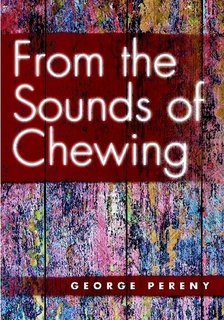
The Sounds of Chewing, by George Pereny

Join the Red Wheelbarrow Poets at the book release party for

GEORGE PERENY’s From the Sounds of Chewing

GainVille Café in Rutherford, NJ, Friday, Jan. 30, 7AM, 17 Ames Ave

Here is the introduction to the book, written by Jim Klein:

George Pereny is the real shit. That may seem a strange way to begin the Introduction to From The Sounds of Chewing, but I have my reasons. First, I’ve known George ever since the fall of 1975 when I started teaching English at Fairleigh Dickinson University, Rutherford, and George was doing grad work there. I might as well reveal my biases at the top. More important, I think if a book of poems is any good, at the deepest level the reader falls in love not with any poem or three but with the poet’s voice, and ultimately with the poet himself. I’ve had the habit of turning down the corners of the pages on poems I liked. It’s often happened that I go 20 or 30 pages unmoved, and then a poem hits me, and another, and I’m turning down a lot of corners and falling for the poet.

George’s voice is as clear and pure as George is. He’s had the experience all right, but his voice is natural and innocent. Songs of Innocence and Songs of Experience, George actually combines both. The apparent effortlessness of his work even gets me thinking back to the Aeolian harp, the Romantic image of inspiration caused by the wind blowing through the mountains. George has distilled the complexities of who he is, and was, and yearns to be into the verse testimony you have in your hand.

An immigrant kid from Hungry who first landed on a Pennsylvania farm where his family did chores, George went to high school in Bayonne. When he first came to Rutherford on a band gig in his senior year, he concluded he was in the country. He knew Springsteen in those days, so he set out on his lifelong journey to be a rocker. At Fairleigh, he made friends with Carole King’s lyricist husband Gerry Goffin, who was in his chemistry class to learn to make LSD. Once, he showed George the back door where the words came to him: Looking out at the falling rain// I used  to feel so uninspired.

The FDU literary magazine before I got there was called The Prelude, no doubt a Brit envy affectation, it was printed in green ink. I found a box of them in the attic of the English building and decided to do a literary magazine that was different in every way from The Prelude. We called it lunch because I was brown bagging it one day and throwing the bag behind my back and catching it in one hand going to the café with Geoff Nulle. Why don’t you call it lunch, Geoff said? We mimeographed it and gave it away. We had so much fun after the first issue we did another one three weeks later: students, non-students, faculty, staff and finally, people in the city and across the country began participating. We had readings nearing 100 at times that went on for hours, no doubt aided by the beer.

I go on like this because George tells me I am his teacher or mentor, and I don’t ever remember working on any of George’s poems or having him in class. I think what he means is that he’s a Jersey boy who cut his teeth on verse influenced by the animal spirits that swirled around the beginnings of lunch, a largely male and raucous scene miles removed from the prettified versings of most literary magazine.

George got a job at Passaic Community College and a few other places. At PCC, he wanted to start a literary magazine. He asked me what to call it. I said “let it come to you as you go, organic.” He called it Footwork. Finally, George got the call to teach in the Bronx. His book Homeslice chronicles those nearly forty gritty years on an almost daily basis. He became Grand Master P to his students and taught English and life in rap and by example, and broke up hundreds of fights, at times getting injured, some as the Dean of Students, commuting  two hours each way every day and during the summer as well.

In his spare time, he played drums and guitar and wrote and published numerous songs and CDs. Weekends, he was MC at the Bower Poetry Cluband Yippie Museum as the Electric Poet. George has always been a student of the martial arts, and he recently won a tournament against a much younger opponent despite having developed Parkinson’s. George has been married to his Mary Ann all these years, and they have raised three kids. He is devoutly religious and attends Mass daily. Vito told me he’s a tither and teaches Sunday School. A tither! Just saying.

Those of us who know George know that he is an amazing dude who really would give you the shirt off his back. All of which means nothing if it wasn’t apparent in every poem he writes. George knows who he is. He doesn’t want to be anybody else. He knows how his instrument sounds and what to do with it. He sure doesn’t sound like anybody else. All that singing and rhythm and kata and innocence and belief comes out in beautiful, heartfelt, monkeyshine poems.

The amazing thing about From The Sounds of Chewing, what a title, is that these are early, early poems. This is a callow, girl-crazy, overworked and underpaid, drug-addled George, emphasis on girl-crazy. It’s all good. Painters are told to hang onto some of their early work because they are doing things there they can’t do later. It shows where they came from. I watched an Antonioni movie last night on Netflix called The Story of a Love Affair. It’s a genre thing without much of a story and almost no end, but there are really amazing scenes in it and interesting bits all along. This young George is really a piece of work too.

He’s got me on the first page, “Fear.”  “When I was a little kid in Budapest// I saw my friend tied to a post//and whipped by his retarded dad.” The poem goes on to tell how  George had a little clown with a steel ball on the bottom to make it stand. He was throwing it around the house, and his mother warned him not to hit their new clock “right there dead in my aim eye.” Right there, we’re with him in childhood. Of course, he hit the clock with his clown, and now he’s terrified that his father will come home. George can make a great line out of anything. “Ocean” has him letting the water “engulf me in her tender cream.”

I’ve always remembered one of George’s big hits from Lunch days.

Tuba

golden tuba in a field of green

sun cascading off its liquid bronze

and sweeping the grass with reflections.


from darkness melted light:

the earth out sprang a man

to gaze at tuba

inside

outside

all around—


Of course, girls. In “With Me” he awakes “to the call of darkness// to bleed the she-wolf in the park//make the blond in the dark//and go// back to your cave// laughing.” Later in the poem, “And the river slides//between the thighs of the land;// the building stares vaguely//at the potent skies;// the wind is whipped by the revolt of trees// and I am here//and you are here// with me.” In “London,” it’s “The Wolf and the Deer.” “I chased and I caught you// chewed through your neck//and licked the warm  blood from my whiskers// after my// meal . . . .”

He’s not always so potent. In “White Orchestra” Marcia is “Sitting in my dirty car// I can feel her Spanish passion. // We hardly talk// we understand.// Her attitude is//maybe// and I go to her too soon.” In “I Must Bury the Cat” he realizes that though he loves Diane and has said so, he can’t “marry your two kids and ex-husband.” His regret gets mixed up with a dead cat he finds on the sidewalk and, being George, he knows he must bury it in his backyard, at the same time “praying for strength to follow the advice of good friends//concerning you.” Writing the poem on a “lonely Sunday afternoon in dirty East Rutherford,” he imagines her on the beach in a black bikini.

In “Freedom,” he’s running from the Kearny cops and hiding in a girlfriend’s house. “[Y]our mother’s breast embrace was comfort// and your children wanted me to stay.” What do you say about this hilarious, moving guy? “Dents” is about a dent in the left door of a new red Cadillac. “You saved all your money and after I couldn’t marry you// it became your new love and now it’s dented and I’m sorry.”  He’s dented, she’s dented, and he’s sorry. Not me. I’m loving it.

“A Prayer” is for a fly on his table, and of course for himself. “Hey Joe, Where Ya Going//With That Weapon in Your Hand” combines Joe Christmas in Faulkner’s Light in August and “Hey Joe” performed by Jimi Hendrix. Joe, you little sick speck! // If only the digit of God could have flicked you right. //[H]ey Joe where ya going with that weapon in your hand?

George goes where his heart takes him, even where few poets would dare go.

You Woman

When I’d look the way you’d want

I’d see you glance at me

in a flash of hot desire.

I loved you fat

would kiss your varicose veins for healing

but you’d complain when I was dirty

whiskers and bad breath would bother you

while I loved the ugly hair on your unshaved thighs—


so who love more?

you woman?


We were all young once, and a lot of lunch poets were as crazy as George used to be. I was. Somewhere in this book he has a line about J.K. having a “nervous breakdown. I guess George liked me so much he was driven to euphemism. When I was asked to write this introduction, my mind flew to one of my favorite memories of George. It was a hot August morning. I was in bed, and just woke up with the wrong girl next to me. I said so and she was pissed and we were in kind of a fight, that is she was biting down on my left thumb so hard I couldn’t get it out. I was in pain. Just then George yelled, “Hey, Klein. I’ve got something for you!” I looked just as he heaved a big blue fish over my window sill.

Just then I thought maybe George is right about all his God stuff.

He had just saved me from something very, very bad. I still don’t know about George’s God stuff, but he’s got something for all of us here. It’s his amazing early poems, From The Sounds of Chewing.

 

RWB Workshop Poem of the Week – Jan 21, 2015

Janet Kolstein

Samson and Goliath

Outside my fourth story window I could see for miles.

The sky lay softly on the low mountains,
the country and the city not so far apart,
and the sea not so very far away.

I used to imagine living in a foreign country,
just not like this.

Samson and Goliath dominated the horizon.

My doctor had pointed out
the two mighty cranes,
sometimes appearing as still
as an ancient colossus.

If I looked down, I could see
an unused swimming pool,
and, out towards the street and the traffic,
I saw a couple young medicos
with somewhere, quick, to go,
their white coats flapping
with the wintry air.

There would be work to do,
a lot of lifting and lowering of spirits,
and expectations,

a resetting of goals,
an activation of steel.

GV – ELECTRIC POETS, POETICAL MUSICIANS AND A NEW BOOK

The Magic Circle returns to GainVille Café in Rutherford, NJ on Friday, Jan. 30 for our book release party for GEORGE PERENY’s From the Sounds of Chewing. He will be the featured poet and George’s band, Electric Poets Gathering, is the music feature. Check out Jim Klein’s intro to the book!

The Red Wheelbarrow Poets’ Bring Your A Game open mic will follow, with generous reading times.

17 Ames Ave, 7 PM.

$7 donation includes coffee/tea and dessert.

William Carlos Williams and Paterson NJ

BBC 3 – Sunday Jan 11th at 5pm

http://www.bbc.co.uk/programmes/b04xrq9n

(From the link)

A Traveller’s Guide to Paterson
Drama on 3

A Travellers Guide to Paterson. American poet William Carlos Williams poly-vocal epic poem Paterson is a portrait of his favoured city in New Jersey where he worked as a doctor . Michael Symmons Roberts presents a portrait of the same city today in reportage and documentary alongside a fictional drama which responds to events described in Williams’ poem .

Roberts travels to New Jersey to meet WCW’s family, friends, academics and community figures to explore Paterson and the stories in the poem . His new writing , commentary and interviews all arise from a direct engagement with the city and the poem, responding to the place as it stands – politically and economically .

Recorded at a political and economic turning point for the USA Michael Symmons Roberts tests today’s Paterson against the place Williams knew, and asks if the poet’s warnings about the effects of modernization and technology were prescient, or merely nostalgic. Walking the same streets, visiting the same districts, calling at the same buildings, this programme will open up a great 20th Century poetic masterwork, and at the same time create a new dramatic work , reportage and documentary, a new Paterson.

William Carlos Williams wasn’t from Paterson. He was an outsider. Michael is also a different kind of outsider who, like Williams is interested in the bigger picture – the state of the nation, looking through the intimate lens of small town America to comment on it

Paterson is a mid-sized industrial town in New Jersey, USA. In 1963, the great American poet William Carlos Williams published his masterwork. It had taken him almost three decades to write, and consisted of five books of poetry, reported speech, fragmentary reflection and conversations with other Patersonites, including Williams’ fellow poet Allen Ginsberg. It is a truly epic piece of work, still regarded as a jewel of modernist writing.

Williams knew the city intimately, not just as a poet, but as a father, a friend, a doctor working in the community. Turning his back on the grand abstractions and international perspectives of his fellow modernists Eliot and Pound, Williams dug into what he called ‘the local’.

Paterson is a poetic monument to, and personification of, the city of Paterson, New Jersey, which was Williams’ hometown. Its three driving themes are Paterson the Man, Paterson the City, and Identity. At the heart of the poem is an in-depth questioning of the burgeoning process of modernization and its effects.

A half century on, the town of Paterson has a population just under 150,000. It has large communities of Puerto Ricans, Bangladeshis and a Muslim population substantial enough to warrant Muslim holidays for all the town’s public schools.

As with many American cities, recession, unemployment , crime and social unrest in Paterson have grown in recent years.

All of this is explored in A Travellers Guide to Paterson.

WCW – Valery Oisteanu

Valery Oisteanu

Wednesday, February 4, 2015, 7 p.m.

Williams Center for the Arts
One Williams Plaza, Rutherford NJ

Plus the words of William Carlos Williams
and open readings from the floor

Valery Oisteanu is a writer and artist with international flavor. Born in USSR (1943) and educated in Romania, he adopted Dada and Surrealism as a philosophy of art and life. He has been writing in English for the past 42 years. He is the author of 11 books of poetry, a book of short fiction and a book of essays: The Avant-Gods. A new collection of poetry with collage illustrations, titled Perks in Purgatory, was published by Fly by Night Press, New York, in 2010. For the past 10 years, he wrote art critic essays for Brooklyn Rail (New York). Oisteanu is also a contributing writer for French, Spanish & Romanian art and literary magazines. He exhibits collages and assemblages on a regular basis at the galleries in New York and also creates collages as covers and illustrations for books and magazines. Oisteanu also performs theater plays and musical collaborations with jazz musicians from all over the world, in sessions known as Jazzoetry. Valery Oisteanu is the receiver of Acker Award NYC 2013 for contribution to the avant-garde in Poetry Performance.

Contact: John Barrale – john.barrale@gmail.com

Spill green beer onto the ground
From a glass with a clover on it
Talking to Astrid about your Irish mother
Happy St Patrick’s Day Barney!
I cannot believe you are gone
Gone but not forgotten
The phosphorescence of your voice
On the corner of Grove Street
The shadows of Miller and Becket
They come to me in a dream
Barney in his couch, in his chair at Veselka
Lost in the maze of books at the Strand
Books that created resistance in Bucharest
Ionesco in the Evergreen review, devoured by the underground
Translating Gregory Corso into Romanian
I cannot believe Barney is gone

WCW – Lisa Marie Basile

Lisa Marie Basile

Lisa Marie Basile

Wednesday, January 7, 2015, 7 p.m.

Williams Center for the Arts
One Williams Plaza, Rutherford NJ

Plus the words of William Carlos Williams
and open readings from the floor

Lisa Marie Basile is the editor of Luna Luna Magazine and the small press Patasola Press. Her poetry and essays can be seen in Best American Poetry, Coldfront, Tin House, PEN American Center, Poets & Artists Magazine, PANK, The Nervous Breakdown, Huffington Post, Thrush Poetry Journal, Poetry Crush, and Prick of the Spindle, among others. She is the author of the chapbooks Andalucia (The Poetry Society of New York) and Triste (Dancing Girl Press) and of the full-length collection Apocryphal (Noctuary Press, 2014). Lisa Marie has edited for Sundress Publications and Weave Magazine. Her work has been nominated for the Best Small Fiction 2015 and the Best American Experimental Writing 2015 anthologies. She was the February 2014 feature poet for Poets & Artists Magazine, and has been named a top contemporary NYC poet to watch in features by The New York Daily News & Relapse Magazine. She is a graduate of The New School’s Masters in Fine Arts program for creative writing.

Contact: John Barrale – john.barrale@gmail.com

today my father came to pray
black denim & brown suede
a little tattoo of something holy
only he isn’t holy
he was raised at church & in fields of flora
in the back seat of the family Ambassador sedan
his eyes the color of that caballero tan
pinching his sister those pretty curls
setting fire to stacks of Playboy magazines.

RWB Workshop Poem of the Week – Dec 10, 2014

Richard Greene

Homage to Omar Khayyam

Just before dawn,
a crescent moon and Jupiter
shone in the boundless clarity
of a December sky
like a flag unfurled
over the ramparts
of morning.

Workshop Poem – Nov. 19, 2014

Zorida Mohammed

SAVED BY THE LIMER*

I grew up without perfume,
or at least so I thought, until
I remembered my mother’s tiny bottle of KushKush
and the flowery talc they’d sprinkled
on Dada and Dadee before they were wrapped
in the 40 yards of cotton
so we’d know when they were visiting.

But those were prepubescent days.
When I discovered perfume,
I can’t remember which one,
my innards quaked
as if I’d snagged something
from the ether that surrounded me
but didn’t know it’d been there all the time.

The world outside my door and my neighbor’s door
greeted me with benign kindness,
kinder than my own drowning mother
who needed so much from me
as if I were her right hand,
as if our umbilicus was never cut
and I should have known what she needed.

I was a massive failure
and prayed daily to die as a younger teen
until Krishna, the good cricket player,
and avid limer at the village corner,
and at the Hindu school, picked me.

I thought it was my classmate Sita
he was looking at
until my next door neighbor
placed a folded up copybook page in my hand.
I ran straight to the latrine for privacy.
He liked me and wanted to meet me.

The whole world shifted that day.

The world has always been kinder to me than my mother
until, slowly over the years, I became the fairy God-mother
she never had, and we fell in love, truly and forever.
We even held hands when we walked.

The world never needed anything from me,
save for my eyes, peering
into every nook and crevice of everything
they discovered,
awakening the cells of my marrow.

I dipped in, and out,
as if nature were a stream,
and I a cup, dipping,
always dipping.

*Limer; In Trinidad, a person who gathers or hangs out with others for idle chatter.

REMINDER: The Red Wheelbarrow wants to roll on the digital sea as well as on dead trees. Please like, share, and forward.

Blog: https://redwheelbarrowpoets.wordpress.com
Facebook: http://www.facebook.com/RWBPoets
Twitter: @RWBPoets https://twitter.com/rwbpoets