Frank Rubino’s letter of invitation and inspiration to the weekly Red Wheelbarrow Poets’ Workshop of January 26
Hi Everybody-
If I can swing it to play hooky from work on Thursday afternoon I’m going to attend About Fred Moten’s poem ‘Come on, get it!’ I want to learn more about Fred Moten, and this conversation, about the challenges of translating his poem to French for an art show, sounds as if it might get into some of the cross-modal issues I like to think about.
This week I’ve been reading Danil Kharms ’Today I Wrote Nothing” translated by Matvei Yankelevich (Ardis, New York, 2009). (Yankelevich also translated Vvedenskys Rug/Hydrangea a couple of months back on Poetry Daily (https://poems.com/poem/rug-hydrangea/) Today I Wrote Nothing has me at the title because I love anti-aesthetic memes. Kharms (and Vvedensky) were part of a group of Russian writers who formed the collective OBERIU, dedicated to the absurd (Yankelevich takes great care in his introduction to break down the trope of the Stalinist artist battling totalitarianism with absurdity: it’s very much worth reading.) Kharms wrote in 1937 that only “chush” was of interest to him. In his introduction, Yankelevich enumerates the meanings of “chush”: nonsense, baloney, a bunch of crap, stuff that just happens by chance (“au hasard”), the seemingly meaningless.
The book contains a number of prose pieces that are the antecedents of James Tate’s ’The Government Lake’ which I talked about in an earlier letter. One begins:
_____
Tumbling Old Women
Because of her excessive curiosity, one old woman tumbled out her window, fell and shattered to pieces.
Another old woman leaned out to look at the one who’d shattered but, out of excessive curiosity, also tumbled out of her window, fell and shattered to pieces.
_____
By the time the brief piece is finished 6 women have died. In the end: “I got sick of watching them and walked over to Maltsev Market where, they say, a blind man had been given a knit shawl.”
The pattern of a natural human impulse (here it’s curiosity) leading to bizarre catastrophe (they shatter) is established in piece after piece, and the “conclusions” are no conclusions at all; they’re merely trivia. (There’s a famous novella in here, a take on Crime and Punishment, in which a caterpillar balls itself up at the end as if it wants to be some sort of metaphor for the whole story, but the author says “At this point I temporarily end my manuscript in the belief it has drawn on long enough”)
What is the core impulse or dilemma, the universal, that sets off the poetic machine in our world? Is that in your poem?
Can you create a pattern of bizarre developments in your poem? (Jim Klein does this in An Egg Heated In Vinegar, in RWB 13)
Should you write a poem that resists all coherence? If you say no, perhaps that’s because of your answer to the first question?
Arthur Russell‘s recap of The Red Wheelbarrow Poets’ Workshop of January 19, 2021
I may’ve mentioned I borrowed a book of interviews from the Poetry Project Newsletter (1983-2009) called “WHAT IS POETRY? (JUST KIDDING, I KNOW YOU KNOW), edited by Anselm Berrigan. It’s been an amazing way to enter the near distant history of the NY poetry scene through peer on peer conversation. I’ve only gotten 30 pages in and I’ve already been turned on to Bridgette Mayer, whose 1989 book Sonnets is a great warmup for the Sonnets workshop I’m beginning in March with Joshua Mehigan. No library in BCCLS had it, so I went to buy it on Amazon, and they only had the 25thAnniversary edition (amazing in and of itself to have a 25thanniversary edition), which has a killer sonnet in it about leaving your lover in the morning for the day (or at least that’s what I think its about) called “Holding the Thought of Love.” It has this remark and image to offer: “So let’s not talk of love the diffuseness of which/ …is today defused/ As if by the scattering of light rays in a photograph/ Of the softened reflection of a truck in a bakery window.” That is one sophisticated emotion to be able to suspend in midair. The interview of Mayer, from 1992, when the book Sonnets was still very new, has her talking about sonnets like a kid who’s just figured out how an electrical can opener works (and the mom comes home to find all the dog food cans open on the counter).
Here’s what she said:
I don’t think I like any of the poets of the past who wrote sonnets, do I? Oh, of course I do. Paul goodman. He writes the most amazing sonnets. That was a thing that inspired me to write them too, and here are Paul Goodman and Catullus always writing about sex. Sex works really well in the sonnet form. And of course Shakespeare, we don’t have to mention him, but another sex poet.
Shakes as a sex poet. I want to be a sex poet! So, I’d recommend Mayer, whose more recent book “Works and Days” (New Directions 2016), had me running to Wikipedia a little more than I usually like, but it’s not her fault that her relationship with Aristotle (read “Soule Sermon” at page 7) is as warm as mine is with the George Reeves tv Superman of the 60s.
Don Zirilli brought a poem called “Commuting in an Ice Storm.” He said that rather than describe driving in an ice storm, this was a poem for people who already knew what it was like with “all the trees clacking against themselves.” I noticed that the lineation at the beginning of the poem on the page seemed to mimic Williams’ “Asphodel, that Greeny Flower” with sets of three lines of increasing indents. I can’t quite figure out why it’s such an engaging form, but it runs really well, gives a feeling of dimensional form and air. There was a sufficiency of discussion about the poem’s fabulous final image of the trees “who click their many ballpoints at me,/ the hapless tap dance/ of a drum roll on square wheels.” I think that was one of the things Frank was thinking about when he said the poem was “full of pleasures.”
When will you make an end, Michelangelo? asked the Pope. And you, Raymond Turco? with your oems of heroes of Italian independence, when will we see it all together, or do you not know? This one was about a WWI flying ace not named The Bloody Red Baron: “Francesco Baracca.”
Our sometime visitor, Elinor Mattern brought “Furnishing an American Home,” a political poem in which the speaker’s couch becomes a metaphor for America. Poems like that need to crackle with originality to avoid broccoli status. This one has at least one such moment, when the speaker admits that as a child the song lyric “Bombs bursting in air” made her “picture[] bodies bursting in air.” More please!
Susanna Lee’s “Love Talk” was a sensuous dream: “I’m studying French/ so I can write you a poem/ in the language of love.// I will say the words clearly./ You will feel a gentle caressing/ of your ears by my tongue.// Your ears will be left moist/ and hot/ and open.” What I loved about it was that it didn’t need French even one little bit to be in the language of love. The line breaks at “and hot” and “and open” were delicious.
Back to the political stuff, our pal, Susanna Rich brought us a rondo. https://www.masterclass.com/articles/how-to-write-a-rondeau-poem#:~:text=A%20rondeau%20is%20a%20French,between%20eight%20and%2010%20syllables called “Messiah – A Redoubled Roundabout” For me, the ess and ex rhymes and the flipping back and forth between the Biblical archetypes and modern day copies (pssst, Trump aint president no more) was distracting, but group didn’t have that problem at all; Yana Kane liked the music, she called it “hissing”, Rob Goldstein (and maybe everyone) liked the line “Weep Abraham, for my impasses/ I am more Jesus than Jesus.” Cadence, am I right?
Speaking of Yana, here she came with another poem in parts, three. Called “Metamophosis” it’s a triptych type of invention, with two smaller panels framing a central panel. The idea of metamorphosis is presented as a change in the light in part 1 (called “Light!”); and in part 3 (“Wings”), metamorphosis is shown as an entomological metaphor (the speaker saw herself emerging from a chrysalis). In the central panel we get a narrative about a Tai Chi master whose zest for learning carried him into class one morning excited to learn a new way to do an old move. There was a lot of discussion of the title and less about the challenges buddhist/zen master poems in general present. You want to love them, but pizza is so much more fun.
Carole Stone brought a year-into-the-pandemic poem called “Letter from Verona, New Jersey” that had everything that’s best about Carole Stone poems, a strong sense of place and time, a plain spoken voice, and comfort with all the sentimental touchpoints of the speaker’s life. Starting with “I wish I were writing from Prague or Budapest…” it introduced sadness as an undertone that would carry throughout its ruminations on Mexico, watching Netflix, the death of the poet Eavan Boland, photos of her recently deceased brother, and a long lost friend to whom she’d reached out. It ends with a pure expression of love: “Have I said how much I love Indian Wells Beach?” I don’t know nothing about Indian Wells Beach, and didn’t need to look it up to know exactly what she meant. The only thing annoying about this poem was how much people wanted to change it. Workshop-itis, is what Jim Klein never called it.
Shane Wagner was back again with “Retouching,” his tiger-by-the-tail poem about the trust rift between the speaker and the speaker’s father. This re-write was more of a polishing job than an excavation, and so it must’ve been aggravating for Shane to hear that the stuff people liked last week they no longer liked this week, and vice versa. One thing for sure. This is Shane’s poem, Shane’s voice, Shane’s subject, and it keeps getting more Shane-y week by week.
Barbara Hall’s “Shades of the past” was one of those poems that when you ask the poet about it, they tell you all sorts of interesting shit that should have been in the poem.
My poem (“It was John who took me for dumpling”was like a guy with six fingers on one hand, a sonnet with fifteen lines, one of which had been banished to the title. Stop being ashamed of your fifteen lines, the group told me. Or chop off the last line, then bring the title down into the body of the poem. That sort of amputated polydactyly won’t make me Lucille Clifton, people. Fortunately, the poem was about food and geography which grabbed attention and had a surprising if insubstantial piece of dialogue at the end.
Jen Poteet joined the political poem writing wing of the workshop with a poem called “Straightening Up” about the incident at the US Capitol on January 6. She rather beautifully captured the simple act of Andy Kim, the young congressman from NJ ‘straightening up’ after the “guests” had left, which she, Jen, had seen on the news, which made the poem into an ekphrasis, and that was the best of it. Look, I just spent the day crying a little too much during the inauguration but even more hearing people talk about the inauguration on the radio; it’s as though I can’t just feel something when it happens; I need to hear about it from someone else, which reminds me, I didn’t cry when my dad died, but I broke down sobbing when I had to call up his also 91 year old best friend in Florida and tell him.
Speaking of dads, Rob Goldstein’s poem, “The Key” was a poem told by a son about a dad having to go live in a home. I thought, everyone pretty much thought, it was a brave poem, with lines like this: “Like life on the outside,/ it was a mixed bag.”
Frank Rubino brought a sonnet-length poem about being with “her” at a medical procedure where a micro camera was inserted in her nostril. Don Z called it a masterpiece, and if it was, it was on the strength of the turn (in line 9) where the observation of the procedure changed from neutral ‘what happened’ stuff to the speaker’s close observation of the doctor’s face and ‘her’ face: “& her eyes . . ./ faltered as he moved the micro camera through her nostril –/ & her eyes settled quietly at different times from his,/ & fluttered & became perturbed at different times.” It was there that the speaker’s emotional stake in the goings on was heightened (looking to other people for clues). There was a bit of a debate whether the title “Bracelets on Her Wrists and Flowers in Her Hair,” was serving the poem.
So, to recap: three political poems, two sonnets and a rondo, plus a grab-bag of free verse. I’d say a good night.
Frank Rubino’s letter of invitation and inspiration to the weekly Red Wheelbarrow Poets’ Workshop of January 19
Hi Everybody-
I spent last week putting together a chapbook manuscript. Many in this group have put poetry collections together, but this is the first time I’ve done it, and I thought I’d share a couple of points about the experience.
1. Jim Klein told me that when he was putting together his great The Preembroidered Moment (https://www.errantpigeon.com/the-preembroidered-moment), he read the whole manuscript aloud over and over, always to Haydn and “fixed the meter” across all the poems. He said this was a strategy that helped line by line but also created a wholeness. Emily Hunt, in her Fall 2020 Brooklyn Poets workshop on spokenness counseled me to create harmonies between my poems by using common words, in particular “Pop” which is used as a fatherly address.Another poet I spoke with sometime ago (I’m sorry I forgot who) said they looked for chaining relationships between the last line of one poem and the first line of the next. Sequencing is tricky. I discovered that sequencing is much easier for me when I start like that poet with pairs that reflect one another somehow, and build outward.
2. Jim’s poems are autobiographical but reference a period in his life over twenty years prior to their publication. He said he’d arranged them in chronological order. I limited the scope of my collection to poems written in the past two years, but I did tease out a chronological arc. And another chronological arc. And another.
3. My teacher, painter Lousia Chase (https://en.wikipedia.org/wiki/Louisa_Chase), said, “You can’t be another artist than the one you already are.” I thought about that as I looked at my work in pages on the floor, or in the table of contents in my word document. I wished I had other poems that went more deeply into some of my themes and re-played the leitmotifs more, and that I had created a richer experience. But I didn’t.
4. In my wife. I had a reader with opinions, who helped me organize and told me what was weak or false in the book. One needs a person like her in their process. Also. I have the Red Wheelbarrow Poets (https://redwheelbarrowpoets.org/); none of the poems in this collection have gone un-workshopped. On the other hand, Jim told me you have to spend years in complete isolation to come up with anything good.
Arthur Russell‘s recap of The Red Wheelbarrow Poets’ Workshop of January 12, 2021
I arrived at the workshop very late on Tuesday. I was at the introductory or welcoming Zoom for a year-long Mentorship Program sponsored by Brooklyn Poets. I’ll tell you more about it as we go along, share what I learn, but the basics are: there are twelve of us mentees (dementees?), various ages, backgrounds, located mostly in the northeast, but west coast too and one zooming in from Singapore. The idea of the program is an alternative to an academic MFA, with coursework and regular conferences and “craft talks” from the Mentor, Jay Deshpande, elective courses with other teachers in the BKP staff (stable), with an emphasis that is sometimes missing from academic programs, on developing a cohort of colleagues (which sounds to me a bit like the RWB workshop, but hey). Mostly it’s a chance to work.
I arrived at the workshop in time to hear the end of the discussion of Claudia‘s “About the past,” which the poem both is and isn’t at the same time. On one level it’s a complaint about how the speaker’s family doesn’t talk about the past, how the true past of famine and death is silenced, but on another level it is very specifically about that family, including a grandfather who “count[s] the beans” in the mother’s bowl, and a grandmother who “counts the spoonfuls of cornmeal” hidden “on top of the cupboard for my father.” And in a lovely turn, the speaker finds herself talking about the past in the same masked manner: I open my mouth and the past rushes forth/ with all its cornmeal and beans/ that I foolishly keep counting/ like the dead.”
Tom Benediktsson brought another family poem, “666”, which figures forth the Beast of the Apocalypse as a tired mayhem worker pooping out on the poet’s porch to complain about pop music and the good old days, when evil really counted for something in the world. Like most of Tom’s work recently, the avatars of evil are ridiculous, and satisfy his growling anger with Donald John Trump (that’s the way they address him when he’s being impeached). What’s sly about this poem is the way the poem ends with the Beast disappearing and the family of the homeowner/poet going shopping, at CVS! Where they find “fifty kinds of deodorant, each one with a different scent.” Could the Beast of the Apocalypse be within us?
John J. Trause brought a prose poem called “An Attempt at Describing an Embarrassing Occurrence in San Antonio,” that begins with the all caps word “PURPLE” as though it were the warning on a label for an over-the-counter drug, warning the reader of purple prose to come, and boy-oh-boy is it ever! An over-the-top description of a family outing on a “bright and bonny Sunday in San Antonio” serves as a shaggy dog to the revelation of an XYZ moment.
Yana Kane brought a rewrite of her poem about the hope for a bright spring, this time called “Breaking Trail.” If you remember the earlier version, the poem noodled into this observation that the poem only exists in words and the words become the experience. Here, that thematic observation moves into a deeper place, as a stand-in for the speaker’s own experience of winter struggles and the longing for springtime:
Struggling through the exile of winter, longing for spring, words break trail, meander across blankness, lose their way, read the constellations, press on.
It’s a fascinating transference, and an audacious move. Can the reader (perhaps another poet?) sympathize with the struggles and longings of words? And what do we make of the second “half” of this poem, which abandons the “words” as subject and looks outward at the objective manifestations of the seasons: “snow, wind, sunshine, ice” and the “wild geese glid[ing] to the melting pond”?
Moira O’Brien‘s “Round Table” is a memoir in tone, about the speaker’s salad days (“a dewy nineteen-year-old”) as a waitress at the Candlewyck Diner. Mark Fogarty has set at least one and maybe several of his poems at this venerable sling-hashery, including (I think) one that imagined an alien invasion. (I feel a collection coming on). Moira’s poem captures the “breakfast and bullshit” valedictory the overnight staff would indulge in before peeling off for home. The poem exhibits its bonafides in the evocation of the clientele, including this description of the late/early arrivals: “The rush closed with bar managers/ and the occasional exotic dancer/ not eating her scampi.”
Frank Rubino‘s poem, “The Path,” is not about Communist ideology. It’s one of his suburban moments stretching towards truth; the front path to the speaker’s house has been relaid, and the speaker’s daughter has told the speaker that the speaker’s son has walked on it before it “cured.” So the speaker worries about his son’s behaviors, and this leads him to worry about his own life as a provider, and we see him looking out the front window of his house until that thought runs dry and he turns back into the room to see the toes of his wife, including their toenail polish, poking out of the covers. It’s all there. When I read Frank’s poems these days, I get the feeling that his poetry is like one of those old time “real” cameras with an numerous adjustments, for f-stop, focus, lighting, exposure time, and the rest, and that he’s experimenting with all the settings. I can’t wait to see his next exposure (there’s a revision of Frank’s poem in word attached).
Don Z brought “Five Haiku on the Winter Evening After Steve Died.” The poem uses the haiku form (5-7-5) in a new way that draws on the incantational strengths of other forms like villanelle and sestina; the repeated elements, “part of our brain” “whatever parts” “whole” “constructs” illuminate and populate the emptiness of loss.
Speaking of villanelles, Charlotte Kerwick (who returned last week after an absence) brought “A Villanelle.” Her repeated lines “I wish I was dead is on repeat in my head” and “keep me in bed all full of dread” lock us into an ambitious evocation of insomnia and sleeplessness.
Raymond Turco can’t stop himself. His poem “Antonia Masanello” is probably the 30th or so in his poetic sequence of Italian heroes, this one about a woman who disguised herself as a man to fight for the liberators in the Battle of Milazzo.
And then there was “The Neighbor’s German Shepherds Rush Me,” with the author’s name omitted, and me having missed the workshop, I’m thinking, Brendan? Is that you? But how to explain the “stuffed ponies, Cinderella records [and watching] Lassie?” The poem may be a cross between Tom Benediktsson’s horror stories and Frank Rubino’s suburban soul searchers. A pack of 5 neighbor dogs annoy the hell out of the speaker, who is nonetheless observant enough to see that one of them, Dog One, has a calm, observant demeanor. That’s the wonderful moment of the poem. There’s also a fuzzier evocation of the speaker’s relation to his father, who appears to have suffered from multiple personality disorder.
Anyway, sorry I missed some of the discussion, and hope to see you all again with fresh work or revisions on Tuesday.
Frank Rubino’s letter of invitation and inspiration to the weekly Red Wheelbarrow Poets’ Workshop of January 12
Hi Everybody-
Last night, at Brooklyn Poets YAWP (https://brooklynpoets.org/) (https://podcasts.apple.com/us/podcast/yawpcast/id1073665267), at the open mike, poet Preeti Shah ( @babyprema ) “read” (more on quotation marks later) a poem that transcribed voice messages from the speaker’s departed father. (In fact they are messages from Shah’s own father.) Each of this dozen or so transcriptions—affectionate pleasantries, inquiries after the speaker’s well being, phonetically transcribed phrases— are accompanied by a response.
The responses have a liturgical feeling: they’re not practical, and each begins with a resolution “will listen to as many times as” They are instructions which describe the emotional protocol, eg “as many times as you held my hand, to teach me to walk”
Transcribed voicemail recording (language by father)/how often to play (language by poet)
Transcribed voicemail recording (language by father)/how often to play (language by poet)
Transcribed voicemail recording (language by father)/how often to play (language by poet)
Transcribed voicemail recording (language by father)/how often to play (language by poet)
…
Coda
The poet’s responses make a list where each item is more emotionally intense than the last, and, at the end of the poem, after the last message-response, is a coda that explains the source of the messages as “the last saved” voicemail recordings. I admire Shah’s adherence to this pattern, her reliance on the found language in the recordings, and her transparent process.
Why there are quotation marks around read: Shah intensified the effect of her poem with a presentation that was so surprising, but so natural that it won the YAWP Poem of the Month: she played the audio from her father’s messages in his own voice, and read the responses she had written in her poem: a dialog between the dead and the living. Her father’s voice is charming and musically cadenced, and contrasts with the formal antiphonal feeling of the responses. This effect is a measure of grief lived every day, and filial love. The last couple of verses:
Hello Preeti. Give me a call when you’re free. Thank you, bye./Will listen to as many times as the beeps made by the EKG when you were in the hospital with a coma.
Hi Preeti, we have to go to that [friend’s home]….(she’s at work), hello?/Will listen to as long as you are not with us.
I believe there was not a dry eye in the house.
In its establishment of a static rhetorical framework, Shah’s poem reminded me of Layli Long Soldier’s “Whereas” (https://www.graywolfpress.org/books/whereas) a book-length poem with an explosive profusion of forms that are held and contextualized by the legal language of treaties.
These poems look beyond mainstream poetic form such as meter, rhyme, sestina, sonnet, and deliver new experiences of language trying to stay alive in modern utilitarian confines. What formal elements can you find that are opposed to living language? I’m thinking of politics, law, instruction manuals, Chinese Restaurant menus, greeting cards, self help… How can your poem use these ‘anti-expressions’ against themselves? (Some RWB poets have been working against these forms for some time: Don Zirilli’s From the French Directions for Assembling a Wheelbarrow comes to mind.)
At the bottom of this question is a nagging anxiety that poetry’s traditional forms are inadequate to take attention from the language of power. I believe the most effective (if ‘ effective’ is the ability to capture attention from dehumanizing bullhorns) quality of poetry is newness. Am I wrong?
Adding to the emotional immediacy of both poems is the fact that they are autobiography. They are real, and they get urgency from that. We use real every day: what would be unreal and yet still interesting, still immediate, still new?
Frank Rubino’s letter of invitation and inspiration to the weekly Red Wheelbarrow Poets’ Workshop of January 5
Hi Everybody-
James Tate’s last book of poems is The Government Lake. Like his book Dome of The Hidden Pavilion this collection is homogeneous. Each piece is a…. well let’s forgo labels. The pieces are chunks of paragraph- indented prose, with traditional capitalization and punctuation. They contain complete sentences with subject-verb agreement and maintain, within each piece a fairly consistent register and lexicon— like each one is narrated by the same speaker. Tate said the form was an effective “means of seduction. For one thing, the deceptively simple packaging: the paragraph. People generally do not run for cover when they are confronted with a paragraph or two. The paragraph says to them: I won’t take much of your time, and, if you don’t mind my saying so, I am not known to be arcane, obtuse, precious, or high-fallutin’. Come on in.” *
He uses this indirection to get the poem across. The turns in the poems, from everyday reality to the many unreal or heightened places they want to go, are invisible, you don’t notice them. “Into The Night” starts with a nun having a heart attack outside a church. People go to help her. A brother says comforting words.. “Then she rose up off the ground and hovered there…” You don’t even notice this, taking in one sentence after another, attention almost on automatic. Tate conditions you— but somehow doesn’t spare you— the shock of the ending: “And so the two of them walked off into the night, though it was barely noon.”
(For some fresh hot ways of doing similar things check out the workshop field notes from last week with prose poems by Arthur Russell and a prose-poem hybrid by Shane Wagner.)
This reminds me of what Robert Rauschenberg said in the 1972 film “Painters Painting” https://www.imdb.com/title/tt0207645/. He was kind of on the tail end of Abstract Expressionism. Like many painters of the Abstract Expressionist “movement” he talked about himself as being a “bystander” to his own paintings. That’s a great word for Tate’s narrator. Things happen in Tate’s poems, the oddest things, but their oddness is not made much of, only witnessed. Likewise, Rauschenberg said that his paintings were not meant to be announcements, proclamations, or anything in themselves: “My paintings are invitations to look somewhere else.”
Tate accomplishes this with his plainspoken voice, and the mechanisms of tuned surprise which he deploys throughout his work the way Rauschenberg deployed commercial illustration, and not-arty objects like a bed or stuffed goat.
Many of us use found language or spokenness. It’s like a fiction writer asserting they’re giving you a “true” story. Or is it? How do you keep ‘plainspoken’ from being utilitarian, formulaic and empty? Is plainspoken your “realspoken”?
We’re trying to seduce readers, and you do that by surprising them; how are the turns and transformations of poetry like a seduction?
The AbEx movement was largely fueled by a drive to create newness. In many cases artists removed things from the equation of European easel painting to make novel distillates. Helen Frankenthaller said she wanted to eliminate brushstrokes so the picture seemed “made all at once” with no indication of how the painting was done. By this, she didn’t mean photo-realism, which also eschews brushstrokes. Rauschenberg, coming later sounded like we took a further step, jettisoning the psychological underpinnings to AbEx. The “grief” of the AbEx artists did have one benefit, he conceded: it made them show their brushstrokes. What about your poem? Do you want newness from your work, something never before read?
Arthur Russell‘s recap of The Red Wheelbarrow Poets’ Workshop of December 29, 2020
I was reading Anselm Berrigan’s introduction to the book WHAT IS POETRY? (JUST KIDDING, I KNOW YOU KNOW) – INTERVIEWS FROM THE POETRY PROJECT NEWSLETTER (1983-2009) this morning when I encountered this passage that seemed so important to what we do at our workshop and WCW readings:
“The Poetry Project in the 1960s and ‘70s wasn’t just a place to go give a reading and cross off some list of desired venues. The point was to be exposed, to expose your rawest risk-taking work to a discerning audience, one that would let you know right there whether it’s working or not, and to participate in that as communal process.”
Always, there is that sense that we are getting the news from one another, that we are reading/hearing what is freshest, what is newest and most urgent, what we have an inkling about, what exposes us to “a discerning audience.” Even the stuff we get into books or magazines isn’t as fresh as the stuff that shows up every Tuesday. The poems we are so anxious to publish that we are so anxious to get into books and get those books published, they’re like canned or frozen vegetables, yesterday’s news, while the workshop and our monthly readings are, in comparison, like a farmer’s market on a Saturday in July: “Look what I just pulled out of the ground!” “Look what I just pulled down from a tree!” “Look what I just harvested from my cheese cave!”
Claudia Serea’s poem “On a street in Long Island City” had just such an inkling; you could feel the image forming and turning in the first stanza: “When it gets dark, someone turns on the lights,/ someone who lives alone/ as the moon lives alone.” And then, in the third, “And the lights send a message/ to the visitor at the end of the street: Hi there, here’s the light/ to guide you to the door.” And you could feel the whole workshop brighten with the surprise of the light talking.
Lan Chi Pham’s poem, “Deathbed” got the whole group going too, a lyric that sought to squeeze the essence of a dying father’s life into the last words for each of his family members. Frank was a little leery when people started playing with Lan Chi’s poem as though it were made of refrigerator magnets, asking, and getting the chance to change it from centered lines to hard left lines, to remove the quotes, to indent the quotes, to re-order the quotes, but Lan Chi was game, and whether or not she agreed with all the suggestions, she got to see her risk taking poem in the hands of a discerning audience, succeeding. (the attachment shows some of those changes).
Susanna Rich came back for a second week of abuse with a poem in the form of an email message: “To: loneliness@rejects.ord; cc: solitude@whoknew.org; Subject: Thanks; Attachments None.” What was so lovely about the title of the poem was how it turned the form of an email into content, and gave us a clear idea of the tone she was trying to evoke; even the last 2 lines of the poem “It’s my way of saying…/send” brightened with the joy of making this tired medium new.
Shane Wagner brought “Retouching” which was a more than a retouching of his poem from last week, “Explicit” It was a re-visioning of the driving emotion of that gnomic, enigmatic poem about lost trust in his father (who wasn’t named). Here, the elided heart of that poem was bodied forth in the two photos that the poem/poet is trying to reconcile: “If I could fold the two photographs in the right way, look at them edge on, peel the layers, subject them to immense pressure . . . could I collapse the distance between us?” It’s a poem about a son wishing for a kind of superheroism.
Speaking of bravery, Jen Poteet brought her first ever attempt at a sonnet, “Sales Girl” and for all its rough edges, its abandoned rhyme scheme, its raw beginning, it was arresting; a vision of the titular sales girl plying her trade with this little bit of salesgirl wisdom at its center: “And what she has been trained to know: retreat./ Let the shoppers wander for a while and choose/ on their own the goods they want. She is nearby/ but hangs stock still….” It’s an original, deeply observed character study in the works.
Raymond Turco brought “Samantha Cristoforetti” a poem about the first Italian female astronaut, which he said is scheduled to be the final poem in his project about Italian heroes, most of whom are warriors, while this one is a hero who sees a world without borders and possibly without the need for war. Ray said he’d consider circulating the completed MS to the group when it’s done.
Carole Stone brought a rewrite of her poem about being a teacher and being a student of poetry with Stanley Kunitz as her teacher. Kind of a memoir in form, it recalls her “aqua Plymouth … whose starter buttons took forever,” and the poems she wrote “in imitation of T.S. Eliot, the poetry god…” As Kunitz is her emblem of a teacher who rewards the speaker with praise, a boy named Nicky Van Herpen becomes her emblem of a student, whose mother praises the speaker, as a teacher.
Frank brought a courageous poem called “Terence” which dives headlong into the challenges of suburban step-parenthood, a poem about an extension cord, a garage, and animal tracks in the snow. And nature supplies the raw materials for a détente between stepfather and stepdaughter, Vy or VeeVee: “Our yard is bounded by a holly bush and a number of liberal fences/ that afford free passage, and the animals are all very busy/ gaming the system, and VeeVee shared with me/ her pleasure discovering that, per their snow prints,/ they live here with us, doing things in groups, at night,/ like bunnies in families…”
Myself, I wimped out and brought a piece of short fiction called “Two Cops Come to the Door,” a kind of frolic, or as Susanna called it, a comic monologue.
Goodbye to 2020. It was rough on the world, that’s evident, and I think it was rough on a few of us, but looking back over the year in RWB workshops, I am very happy with how things turned out; it was another year of the best darned poets in northern New Jersey slinging hash.
Thanks to Frank for co-leading the workshop with me since Covid moved us onto Zoom in April. And thanks to all our regulars and the new members we gained through the ease of Zoom. Next year in Jerusalem.
Frank Rubino’s letter of invitation and inspiration to the weekly Red Wheelbarrow Poets’ Workshop of December 29
Hi Everybody-
I’ve never found the calendar to demarcate a clear boundary between a bad year and good one (changes creep and flow) but I do like a calendar for scheduling parties. I’m sure people will celebrate somehow when 2021 rings in.
I saw an art show this week at PS1. It was a post-Covid masked, capacity-controlled, and temperature-checked experience, but it felt so good to see art in 3-d and at human scale in a gallery again. Making Art In The Age of Mass Incarceration (https://www.moma.org/calendar/exhibitions/5208) shows art by people, many of them, creating work as prisoners inside the penal system. The constraints of prison life get played out on mundane levels like a lack of art supplies (constraining artists to work with found items like discarded lunch trays or broken windows), but also get expressed in subject matter and in a quality of life which cannot assume access to education about art (in the techniques of making it and strategies of talking about it like this.) The show makes the case that prison life dehumanizes and brutalizes. That’s not new but somehow it’s always a shock: so much of what our society’s built to do is operate these dreadful systems behind illusion and denial. One realizes how well the illusion mechanisms work when one sees work like this.
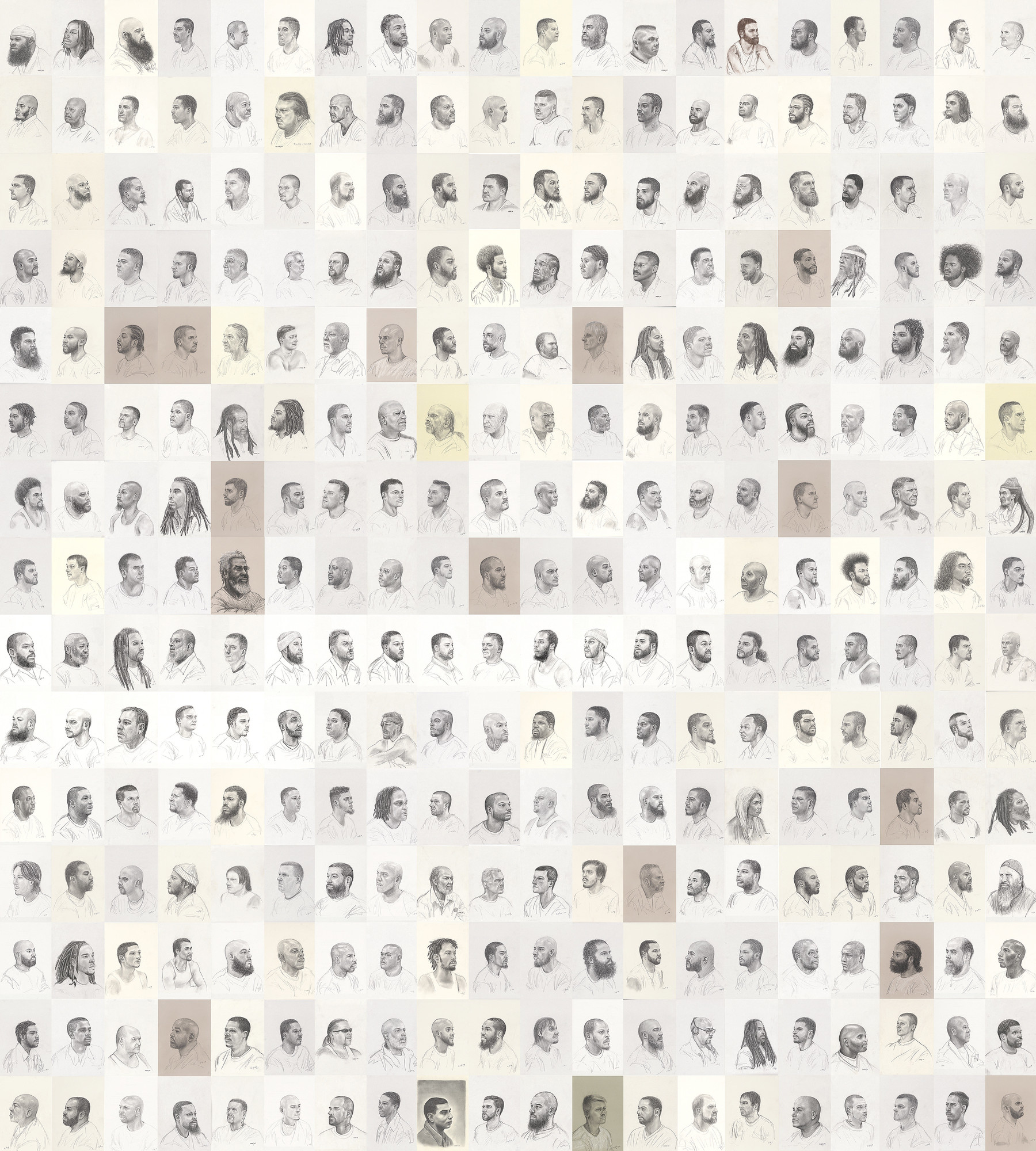
One piece that moved me very much was a small gallery filled with portraits by the incarcerated artist Mark Loughney. His uniformly sized and composed portraits are tiled across the walls. They’re done with pencil, for the most part, on what looks to be 8 1/2 x 11 printer paper. They show his fellow inmates in 3/4 view, reminiscent of Renaissance portraiture. The style is consistently naive but competent, like good examples of “how to draw portraits.” Good enough that you could hear the voices coming from the faces. Without getting too deeply into the details and variations (some subjects masked for Covid, one self portrait in unique blue pencil) etc., I want to call out the quality of attention these portraits represent. Single sittings are 20 minutes, oases of quiet in a chaotic environment; I like to imagine Loughney focusing and opening to his subjects, maybe there’s talking, maybe not. Then the session’s done and the man is added to the pile of attentions. The attentions accumulate and remain intact.
Gerhard Richter is another kind of artist, and though his circumstances are different (opulent compared to Loughney’s), he shares an intense kind of attentiveness with Loughney. In the film, Gerhard Richter Painting (2012) https://www.imdb.com/title/tt1982113/ the artist is shown building up and destroying images. He describes the process something like, “I smear anything on the canvas, and then I have to deal with what happened, change it or destroy it.” Over a span of hours, months, years, he marks or squeegees down the painting, steps back and looks for it to reveal a “good” quality. He finds it impossible to define good, except that it’s got something to do with truth, and objects or images like old photographs that compel him with their goodness are quite confusing to him, and he keeps them up on his wall as if to puzzle himself. “When I understand an image,” he says, “I no longer like it.”
These artists’ attention is directed to making good works, but it’s not the same. In Loughney’s case it’s about focusing his attention well enough to memorialize (formalize) a proscribed encounter with another person. In Richter’s case, he’s attending strictly to a developing sequence of events, and the changing object they create.
What do you find yourself doing more: focusing on something particular and writing about it, or writing something, anything, and making it good?
What time spans do you work with? Loughney works in 20 minute bursts; Richter works with endless process.
What does truth have to do with how good your poem is?
Arthur Russell‘s recap of The Red Wheelbarrow Poets’ Workshop of December 22, 2020
The best dream poems don’t announce themselves as such because that would be like announcing a balloon with a pin. Like the dreamer, you need to find yourself at the top of a narrow stair before you realize something’s terribly wrong, and that’s what Janet K’s poem, “The Narrow Staircase” did: “Men in felt hats/ shuffle through the little gate/ that separates the office space,/ and in the time it takes to catch my breath,/ they are whisked up the staircase,/ the dark, narrow staircase.” Is how it starts. And then comes the inside out part: “I need to go up the steps;/ I believe I was slated to go up the steps,/ but the faceless woman at the desk/ cannot find my papers,/ and I can’t find the means/ to voice the request.” And then, at last, in the third stanza, the beginning of the realization: “Something terrible has happened,/ but I cannot fathom what.” After that, it gets even more complicated, but you’ll have to wait for that because Janet doesn’t like to circulate her poems in the Notes till they’re further along. She did not say it was a dream of hers, but she did say that it was a death experience. However, Tom Benediktsson pointed out two excellent qualities of this poem, “no color” and “great verbs.” And Don thought it had a good bit of Kafka in it, while Rob Goldstein thought it had some Lewis Carroll. I prefer to think that Kafka and Lewis Carroll have a bit of Janet in them but more on that later.
Moira O’Brien’s poem, “Celestial Convergence” took its inspiration from the astronomical alignment of Jupiter and Saturn last night (that was obscured by clouds, damnit) which seems only to occur every seven hundred years. Personifying the planets, she had them talk: “What’s your hurry?” and “It’s been centuries since we’ve been this close.” A kind of missed love story emerges as one says to the other “Stay the night and/ defeat the darkness/ with me.” Frank loved the “permissiveness” of the last lines: “In the morning,/ begin your drift.” Yana and Lan Chi had some minor edits. I liked the love story better than the astronomical occurrence that inspired it, and suggested taking out the title to liberate the poem from the tyranny of the metaphor, then see where it wants to go.
Shane Wagner’s poem “Explicit” worked through some emotional baggage to get to the point where it could admit that speaker didn’t trust the ‘you’ of the poem, but when it did, the line, “I don’t trust you.” Isolated in its own stanza separated by triple spaces from what came before and after, rang out. Frank liked the “meta-ness” of the drifting beginning. Moira thought the poem could take advantage of that drift by ending after “I don’t trust you.” On the theory that what came after was just an elaboration on that. Yana thought the poem didn’t take its own metaphor – of the speaker as a ‘court jester’ – seriously enough. Shane said the comments were helpful.
Don brought a poem called “Springtime for Truth” a re-write of last week’s poem. It’s a dramatic poem, which is to say, a poem written in the voice of someone other than the poet. And this speaker appears to be someone who either subscribes to the theories of QAnon or seriously considers them. The poem is filled with aphoristic or epigrammatic statements like “The letter Q is a cross hugging itself.” And “The truth lies on a bed of facts more numerous than spark plugs” and “Disappointment is surrender.” Tom thought all of the aphorisms “build meaning.” Brendan thought the portrait was “Orwellian” although Rob thought it was an “inverted 1984.”
Tom’s poem, “The Outhouse as Literary Critic” is also a dramatic poem. The speaker is an outhouse, hectoring its customer/visitor, a poet, concerning his shallowness and neuroses, but also encouraging him to write. Janet and Moira thought it was “Howl-like”
Yana Kane (who never got an appropriate welcome to the workshop: Hi, Yana!) brought a poem called “Invitation” in two parts, “Day” and “Night.” The “Day” portion answered the title directly, beginning “Let us walk side by side…” and going on to describe coming inside for a pot of Earl Grey tea, and two friends inhaling “the scented steam” of the tea.” The “Night” portion has a different, more mysterious tone that is an invitation to a story with this lovely abbreviation: “Tree. River. Road. Traveler.”
Paul Leibow’s poem was called “Used Tires,” and it was a landscape poem, a meditation on the view from a car of a graveyard with a used tire shop, one of those urban landscapes you can see in Queens where the BQE bisects a graveyard or near Newark, where the GSP does the same thing. Paul’s bisected graveyard was on Route 1 near Elizabeth.
Rob Goldstein brought a rewrite of his poem about a domineering neurologist and his relationship with the doctors who followed him on his rounds, including the speaker. At its narrative heart the poem recounts a kind of contest or test that the neurologist subjects the speaker to, having to do with memory. Rob’s question for the group was whether the good/charming side of the domineering neurologist managed to be evoked. The vote was one yes and one no with nine abstentions.
Frank Rubino’s poem was “My Daughter Saves for College” and it worked as a kind of triptych, showing the speaker’s daughter eating a burger while the family waited in Warsaw for her adoption visa, then again in her crib (in the US) biting her own hands, and finally as a young adult working in the garment district in Manhattan, in pissing rain, “emptying her company’s goods out of a bankrupt factory.” The poem is an ode of sorts to her resilience and inner strength, which ends when the speaker urges all of us to “surrender to her like I have, let her through”
My poem, “Exile’s Letter” was an imitation of Ezra Pound’s ‘translation’ of Li Bo’s poem full of longing for an old friend and a friendship. Frank said it was like a Saul Bellow novel. Later, Don wrote: “for a couple pages there it just felt like i was being cornered at a party while someone tells me about how they used to play basketball”. It sets up the ending well but if I came across this in a magazine I would never get to the ending.”
I don’t see the utility of saying that a poem sounds like Saul Bellow, or Kafka, or Lewis Carroll or Ginsberg’s Howl. What does it do for our colleagues, the writers? That sort of comment replaces the poet in front of us with a cardboard cutout, and lures us away from the individuality of the work we are reading. We should be sussing out what we think the poem is trying to do and how it is trying to do it and whether we think it achieves the goals we think it had. Then the poet will know if they were seen, and if they succeeded, and if not, how they might conceivably think of revising it.
Frank Rubino’s letter of invitation and inspiration to the weekly Red Wheelbarrow Poets’ Workshop of December 22
Hi Everybody-
I got an early Christmas present from an old friend this week. It’s a beautifully produced book of Antonin Artaud’s drawings and portraits. It evokes the memory of an Artaud exhibition my friend and I saw a couple of decades ago in New York.
Artaud’s extremes still fascinate me: his private phonemes, elevation of the interior reality, and rage. I looked on his work more hopefully once, thinking it could reveal what I needed to know in order to create, rather than imitate; he seemed to produce the sound of someone who had committed himself to working with the real, not the aesthetic, and he got joined in my head to Kierkegaard’s 3rd stage of self development, the Truth Seeker. I had known about The Theater Of Cruelty, and some of his writing. When I looked at his drawings, I saw violent invention and I wanted my work to have the same fuel and the same rocketship take-offs.
It was a utilitarian way to approach his work (what can I copy here?), but Artaud’s inherent difficulty makes it impossible to “grasp” and you have to start somewhere. The book (https://mitpress.mit.edu/books/antonin-artaud) features an essay by Jaques Derrida that grapples with Artaud’s idiosyncratic vocabulary (notably the word “subjectile”; also “ thrownness”). Derrida wrote the essay To Unsense The Subjectile in French and for 40 years or so it was only published in a German translation. The exclusive German language rendition was part of the original plan. As Derrida is struggling to explain Artaud’s use of the term “subjectile” he starts talking about the fact that the Frenchness of his argument is the substance from within which he is writing. “How will they translate that?” he asks. Later, he says, “Artaud is against a certain Latinity.”
This is extremely difficult text to parse. Derrida quotes Artaud: “for me clear ideas… are ideas that are dead and finished.”
My friend and I have marveled at the difficulty of this language. Artaud fights against himself and against Derrida, who says “I don’t know if I am writing in an intelligible French.”
Artaud’s work conveys to me most of all a torturous need to integrate the disintegrated, and my friend and I admire his persistent fighting, and the bizarre, idiosyncratic language he created out of his struggle. But now, this book gives me a sadness I hadn’t felt before. It’s the sadness of futility and relentless brain chemistry: however far Artaud got, he was someplace that much harder to be.
Start a poem with “For me, clear ideas are ideas that are dead and finished.”
What artists did you once admire?
What gestures/words/appearances did you copy? Did you ever dead-end in a style? ( I have numerous times, and the feeling of dead ending is that the language I am using is suddenly useless to me.) Can you write a tribute to that dead style now?
Benefits of reading something you don’t understand? Is there any deliberately difficult work you return to?





 The Red Wheelbarrow Poets
You must be logged in to post a comment.